
Article
AI for trade shows: where it helps (and where it does not)
A plain-language map of AI across the trade show lifecycle — selection, prep, booth day, and follow-up — with guardrails for B2B exhibitors in 2026.

Article
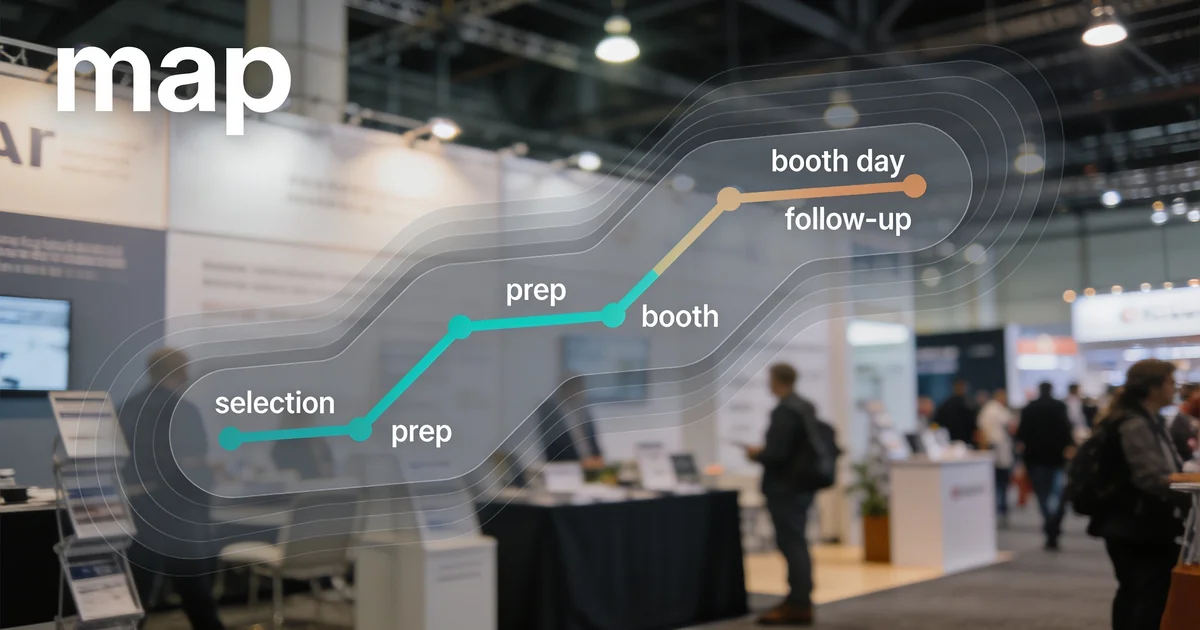
Short answer: AI for trade shows works best as a lifecycle map, not a shopping list. AI assists in six phases — selection research, budget modeling, script drafts, note summarization, follow-up drafts, and debrief synthesis — while human judgment stays non-negotiable for ICP qualification on the aisle, pricing promises, and attendee list buying. Scale effort by show tier; verify every fact AI produces before budget or send decisions.
When I audit exhibitor calendars before 2026 season, AI adoption splits into two camps: teams that bought subscriptions with no workflow attached, and teams that banned AI entirely because someone auto-sent a follow-up with the wrong buyer name. Neither camp has a map. This guide is that map — where AI accelerates prep and post-show work, and where a human must still own the decision. It is intentionally different from our ten AI use-cases by tool category listicle, which names jobs and software categories. Here you get the landscape: phase by phase, assist versus judgment. For rollout rules and a 30-day adoption plan, see AI for exhibitors; for lead-specific workflows, see AI lead generation at trade shows.
The exhibitor lifecycle map
B2B exhibiting moves through predictable phases. AI belongs in some; in others it creates liability. I frame every audit around this table — not which product to buy, but who signs off at each step:
| Lifecycle phase | AI role | Human role |
|---|---|---|
| Selection research | Synthesize ICP fit, sector density, calendar conflicts from verified data | Approve dates, attendance claims, deposit decision |
| Budget modeling | Draft line-item scenarios by show tier | Verify quotes, hidden costs, finance sign-off |
| Script drafts | Generate conversation starters and objection bridges from ICP brief | Rehearse aloud; run live qualification on the aisle |
| Note summarization | Structure voice memos into CRM-ready fields | Assign hot/warm/cold tier; confirm next step |
| Follow-up drafts | Produce tier-specific email variants from booth notes | Review and send; never auto-send hot leads |
| Debrief synthesis | Merge rep notes into rebook narrative | Own pipeline math, ROI, and 2026 calendar call |
Three zones sit outside this table entirely — covered below — because delegating them to AI breaks trust, compliance, or pipeline quality.
Phase 1: Selection research — AI synthesizes, humans approve
Show selection is where AI saves the most planning hours when inputs are clean. Start from verified listings on ExhibitionsVoice, not from a model's memory of event names. Paste organizer-confirmed dates, sectors, and geography into your assistant; ask for a shortlist memo: ICP overlap, competitive density, travel burden, and calendar conflict with existing Tier A slots.
Where AI helps: comparing five to ten candidate fairs side by side, summarizing attendee profile language from public show marketing pages, and flagging obvious ICP mismatches before anyone requests a booth quote.
Where human judgment wins: verifying attendance figures, confirming buyer titles actually walk the aisle (ask peers, check past exhibitor lists), and deciding whether the all-in cost fits your Tier A/B/C budget framework. AI confabulates stats — if a number cannot be traced to an official organizer page, delete it before leadership sees the memo. For prep-task sequencing once a fair is shortlisted, pair this phase with AI event planning for exhibitors.
Phase 2: Budget modeling — AI drafts scenarios, finance owns numbers
All-in exhibit economics confuse teams because booth rent is only one line. AI can draft scenario tables — rental versus owned build, domestic versus international freight, staffing headcount by shift — aligned to the tier you assigned in selection. That draft saves spreadsheet setup time.
Where AI helps: structuring line items (space, build, graphics, labor, freight, drayage, lead retrieval, travel), producing three scenarios (lean, standard, flagship), and narrating tradeoffs in plain language for finance review.
Where human judgment wins: every dollar that hits a purchase order. Vendor quotes, show manual service categories, and hidden fees from prior years beat any model estimate. AI does not know your negotiated freight rate or whether the union jurisdiction at a venue adds overnight labor. Finance signs the scenario; AI never approves spend.
Phase 3: Script drafts — AI writes starters, humans qualify live
Three weeks before move-in, feed your ICP brief, demo hook, and disqualifiers into an assistant. Request conversation starters — question-led, pain-led, demo-led — plus two objection bridges. Output is a rehearsal deck, not a teleprompter script.
Where AI helps: variant generation when marketing and sales disagree on opener tone; localization drafts when a regional show needs different pain language; quick refreshes when a competitor announces a booth theme you need to counter.
Where human judgment wins: everything that happens on the aisle. Buyers detect read-aloud scripts instantly. The rep who spoke assigns tier and next step — AI does not stand in your booth. Script drafts support lead workflows; they do not replace them.
Phase 4: Note summarization — AI structures, humans tier
During show hours, reps record 30-second voice memos walking away from conversations. Transcription plus formatting produces fields: role, pain, timeline, competitor mention, suggested tier. That structure is where AI earns its keep — not in guessing whether the lead is hot.
Where AI helps: turning messy audio into CRM-ready text, deduplicating company names, and suggesting follow-up talking points for the AE handoff.
Where human judgment wins: tier tagging and consent. The rep who heard tone and budget authority assigns hot, warm, or cold. Privacy rules at some venues restrict recording — check show policy before you deploy transcription on the floor. Summaries are drafts until the owner approves.
Phase 5: Follow-up drafts — AI writes, humans send
Day zero through day three post-show, paste anonymized note fields into your assistant and request tier-specific drafts: hot same-day with meeting ask, warm with asset link, cold nurture with no hard pitch. Structure should mirror your existing follow-up framework; AI fills the first draft only.
Where AI helps: batching ten to twenty variants when five reps captured notes in different formats; maintaining consistent subject-line patterns; translating notes into executive-summary language for internal Slack updates.
Where human judgment wins: send authority. Account executives review every hot lead draft — AI hallucinates meeting times and product details. No auto-send rules, no CRM triggers firing nurture before human spot-check. This phase is the bridge between booth conversation and pipeline; treat it like outbound sales, not marketing automation.
Phase 6: Debrief synthesis — AI narrates, humans decide rebook
Within 72 hours of move-out, feed raw rep notes, scan counts, and meeting outcomes into an assistant. Request sections: ICP fit, operational failures, competitive observations, rebook recommendation. Narrative synthesis is AI's strength; arithmetic is not.
Where AI helps: merging five rep perspectives into one leadership memo, surfacing repeated buyer objections, and documenting booth logistics failures while memories are fresh.
Where human judgment wins: pipeline added, cost per qualified meeting, and the rebook yes/no call. LLMs do not calculate ROI — spreadsheets and CRM reports do. Use AI debrief for the story; use your budget framework for the math.
Three zones where AI must not decide
These sit outside the lifecycle map on purpose. I flag them in every exhibitor audit:
- ICP qualification on the aisle. Models cannot read body language, budget authority, or timeline urgency. AI may draft qualify questions; only the rep who spoke assigns tier and books the meeting.
- Pricing promises. Discounts, custom packaging, and contract terms require human authority. Never let AI-generated email copy imply pricing you cannot honor — buyers will hold you to it.
- Attendee list buying. We are a directory, not a lead broker. "AI-generated attendee lists" are policy and privacy risk with no pipeline quality. Build pipeline from conversations you earn on the floor, not purchased spreadsheets.
Violating any of these three rules burns credibility faster than skipping AI entirely.
Scale the map by show tier
AI hours are finite. Score your calendar before assigning phases:
- Tier A flagships — run all six assist phases; debrief synthesis and budget scenarios earn their keep when rebook decisions carry six-figure weight
- Tier B regionals — selection, scripts, notes, follow-up drafts; skip heavy debrief automation until the fair repeats
- Tier C tests — selection research only; validate buyer density before investing in booth AI workflows
Tiering prevents building an AI pipeline for a fair that never matched your ICP. Fix show selection on ExhibitionsVoice before you optimize prompts. For tool-category detail on each phase, see ten AI use-cases every exhibitor should know; for team rollout gates, see the adoption guide.
How this map differs from a tools list
Tool articles answer "what category fits this job?" This map answers "who owns this decision at this moment?" That distinction matters when marketing buys an AI subscription and sales still qualifies manually with no shared rules. Walk the lifecycle once with your team: mark each phase assist or human-only, name reviewers, and attach the map to your show brief. One disciplined map beats ten disconnected tools.
FAQ
Where does AI help at trade shows?
AI assists in six lifecycle phases: selection research synthesis, budget scenario drafts, booth script drafts, lead note summarization, follow-up email drafts, and post-show debrief narrative. Humans approve outputs, verify data, and own tier tags and send decisions.
Where should exhibitors not use AI at trade shows?
Do not delegate ICP qualification on the aisle, pricing or discount promises to buyers, or attendee list purchasing to AI. These require live judgment, commercial authority, and compliance review that models cannot provide.
Can AI replace booth staff qualification?
No. AI can draft qualify scripts and summarize notes afterward, but the rep who spoke with the buyer must run live qualification, assign hot/warm/cold tiers, and confirm next steps before CRM sync.
How does AI fit into trade show follow-up?
AI drafts tier-specific emails from booth notes — hot same-day, warm with asset, cold nurture — after the show. An account executive reviews every hot lead draft before send. Pair with the lead generation workflow guide for sequencing and timing.
Is AI useful for trade show selection research?
Yes, when fed verified directory data and official organizer pages. AI synthesizes pros, cons, and ICP overlap into a shortlist memo. Humans cross-check dates, attendance figures, and budget fit before deposit.
What is the difference between AI tools and AI workflow for exhibitors?
Tool lists map jobs to software categories. A lifecycle map — this guide — shows when AI assists each phase and where human judgment is non-negotiable. Start with the map, then pick tools by use-case.
The exhibitor lifecycle map (AI assist vs human judgment)
Six phases where AI accelerates prep and post-show work; three zones where humans must own the decision. Pair with ten use-cases by tool category for implementation detail.
Phase 1: Selection research — AI synthesizes, humans approve
AI compares sector density, geography, and ICP overlap from verified directory data on ExhibitionsVoice. Humans approve dates, attendance claims, and rebook decisions. See AI event planning for exhibitors.
Phase 2: Budget modeling — AI drafts scenarios, finance owns numbers
AI produces line-item scenario drafts aligned to show tier. Humans verify booth rent, freight, labor, and hidden costs against vendor quotes. Cross-link Tier A/B/C budget framework.
Phases 3–6: Prep through debrief
Script drafts, note summarization, follow-up drafts, debrief synthesis — AI assists; humans rehearse, tier, send, and decide rebook. Deep dives: AI lead generation, adoption guide.
Three zones where AI must not decide
ICP qualification on the aisle, pricing promises to buyers, attendee list buying — human-only. No product endorsements; no scraping.
Scale AI effort by show tier
Tier A: full lifecycle map. Tier B: selection, scripts, notes, follow-up. Tier C: selection research only until the fair earns rebook.
Common exhibitor questions
Where does AI help at trade shows?
AI assists in six lifecycle phases: selection research synthesis, budget scenario drafts, booth script drafts, lead note summarization, follow-up email drafts, and post-show debrief narrative. Humans approve outputs, verify data, and own tier tags and send decisions.
Where should exhibitors not use AI at trade shows?
Do not delegate ICP qualification on the aisle, pricing or discount promises to buyers, or attendee list purchasing to AI. These require live judgment, authority, and compliance review that models cannot provide.
Can AI replace booth staff qualification?
No. AI can draft qualify scripts and summarize notes afterward, but the rep who spoke with the buyer must run live qualification, assign hot/warm/cold tiers, and confirm next steps before CRM sync.
How does AI fit into trade show follow-up?
AI drafts tier-specific emails from booth notes — hot same-day, warm with asset, cold nurture — after the show. An account executive reviews every hot lead draft before send. See the lead generation workflow guide for the full sequence.
Is AI useful for trade show selection research?
Yes, when fed verified directory data and official organizer pages. AI synthesizes pros, cons, and ICP overlap scores into a shortlist memo. Humans cross-check dates, attendance figures, and budget fit before deposit.
What is the difference between AI tools and AI workflow for exhibitors?
Tool lists map jobs to software categories. A lifecycle map — this guide — shows when AI assists each phase and where human judgment is non-negotiable. Start with the map, then pick tools by use-case.
Editorial standards & corrections
This guide is maintained by the ExhibitionsVoice editorial team. We cross-check dates, venues, and organizer names against official sources before listing events. Spot an error? Use our contact form with the event URL and corrected details — every correction request is read by editorial.
Read more: About ExhibitionsVoice · FAQs · All exhibitor guides
Related articles
Oil and gas trade shows 2026: energy calendar and how to pick
Oil and gas trade shows for 2026 — ADIPEC, WETEX, and offshore energy fairs we score for NOC, IOC, and energy-tech exhibitors.

CPHI India 2026 exhibitor guide: Delhi pharma ingredients floor
CPHI India 2026 exhibitor guide for 23-25 November at IICC Yashobhoomi, New Delhi — API, CDMO, and packaging teams scoring South Asia's ingredients floor.

Fintech trade shows 2026: payments calendar and how to pick
Fintech and payments trade shows for 2026 — Money20/20 USA, Sibos, and how banks and vendors pick Tier A/B/C money-ecosystem floors.
ADIPEC 2026 exhibitor guide: Abu Dhabi energy floor
ADIPEC 2026 exhibitor guide for 2-5 November at ADNEC Centre Abu Dhabi — who should exhibit, hall logistics, and how we score the energy floor.