
Article
Portable trade show displays: when they win (and when they fail) in 2026
When portable trade show displays are the right buy — cost, freight, and brand limits — plus 2026 kit types that survive multi-show calendars.

Article
Short answer: Portable trade show displays win when your team needs a repeatable 10x10 or 10x20 presence, low freight risk, fast setup, and a brand system that can survive several regional shows in 2026. They fail when the brief requires private meetings, heavy product demos, hanging signs, custom lighting, or flagship presence. We usually treat portable as the best first buy for Tier C and many Tier B shows, then compare it against rental, modular, and custom options before scaling the calendar.
When I review a new exhibitor budget, I do not start with the prettiest rendering. I start with the calendar: how many shows, how far apart, which cities, how many staff, and whether the team can carry the kit without creating a logistics mess. Portable trade show displays are not a downgrade by default. They are a tool. Used well, they protect budget, shorten move-in, and let our team learn which events deserve bigger investment. Used badly, they make a serious B2B offer look temporary.
What counts as a portable trade show display?
I define portable as a booth display that a small team can ship economically, assemble without specialist carpentry, and reuse across several shows without a rebuild. That includes pop-up backwalls, tension fabric frames, tabletop displays, banner kits, lightweight counters, and small modular systems packed into wheeled cases. It does not include a full custom stand that happens to be crated, and it does not include a space-only build that needs venue labor for every structural element.
The practical question is not "portable or professional?" It is "portable enough for our logistics, professional enough for our buyer?" A clean fabric backwall with a strong headline, one demo monitor, and a trained greeter can outperform an overbuilt rental at a regional fair. At a flagship show, the same kit may disappear beside custom islands. That is why we compare portable spend against our cost to exhibit at a trade show guide before signing a multi-show plan.
Portable display types and 2026 cost ranges
Costs vary by print quality, frame durability, case type, counter options, lighting, and whether the supplier includes design. These are planning ranges I use before vendor quotes, not a substitute for show-specific service forms.
| Portable display type | Typical use | 2026 planning range | Watch-outs |
|---|---|---|---|
| Retractable banner kit | Tabletop or small regional booth | $300-$1,200 | Weak as a full booth backdrop; easy to look generic |
| Pop-up fabric backwall | 10x10 starter booth | $1,500-$5,500 | Limited depth, poor private meeting support |
| Tension fabric frame | Polished 10x10 or 10x20 | $3,000-$10,000 | Graphics must be reprinted carefully for updates |
| Portable modular kit | Multi-show 10x20 calendar | $8,000-$25,000 | Needs stronger inventory discipline and cases |
| Portable counter and monitor package | Demo-led small booth | $1,000-$4,500 add-on | Electrical, mounts, and cable routing often excluded |
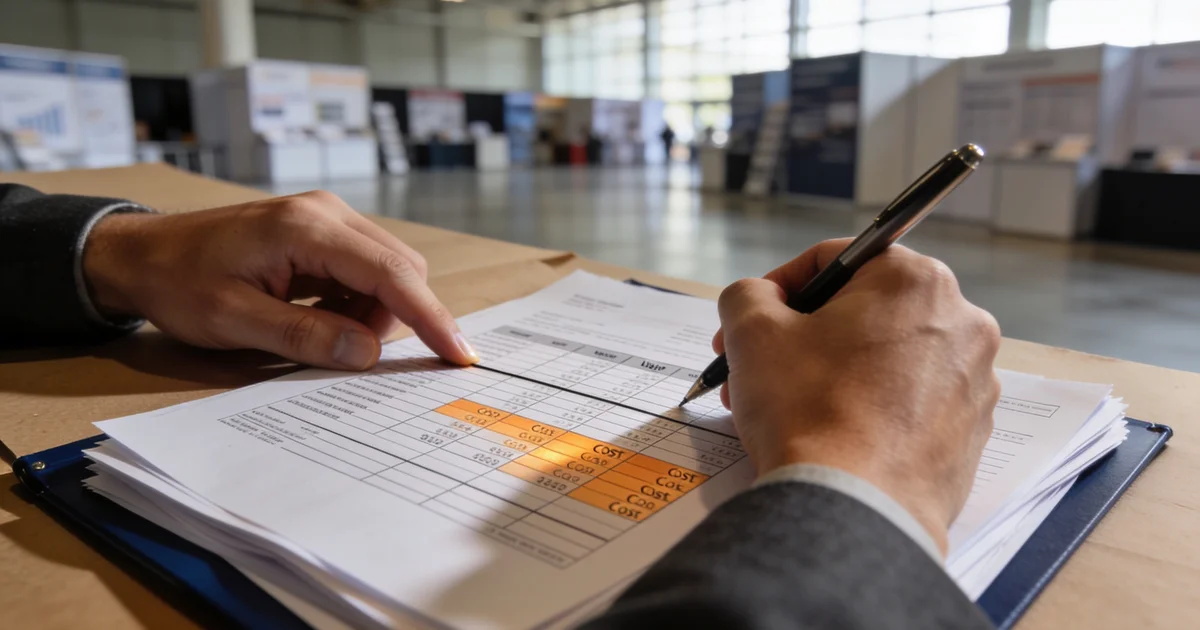
These ranges are only the display asset. Your all-in show cost still includes booth space, travel, lead capture, services, and follow-up. I cross-check every portable quote against our average booth cost breakdown so the team does not mistake display purchase price for exhibit budget.
When portable beats rental, modular, or custom
Portable displays win when the same message travels to several similar shows, especially when the shows are Tier C validation events or Tier B regional events. If we are testing an industry vertical, I would rather buy a strong portable system and spend the savings on pre-show meetings than overbuild for a hall we may not return to. Our B2B show budget selection framework is the filter I use: Tier C validates, Tier B repeats, Tier A deserves heavier presence.
Portable also wins when freight risk is the main threat. A compact kit avoids large crates, material handling surprises, and late drayage stress. If your team has been burned by freight, read the all-in warnings in our trade show cost guide before assuming a custom build is the safer route.
Rental can beat portable when you exhibit once in a faraway market and do not want to own assets. Our rent or buy booth guide covers that decision in detail. Modular hire can beat portable when the brand needs a larger European presence without buying inventory, which is why we link London exhibitors to our modular exhibition stand hire London guide. Custom can beat portable at flagship shows where meeting rooms, rigging, premium finishes, or deep product demos matter.
The freight math most teams miss
A portable display looks cheap until the team treats it casually. I want every kit to have a freight plan: case dimensions, packed weight, number of cases, who owns outbound shipping, where the return label lives, and whether staff can move it through the venue without violating rules. The cheapest display is not cheap if it arrives damaged, misses the advance warehouse deadline, or forces a rush print two days before move-in.
| Cost line | Portable planning assumption | Why it matters |
|---|---|---|
| Outbound shipping | $150-$900 domestic for small kits | Small cases avoid freight minimums but still need tracking discipline |
| Material handling | $0-$1,500 depending on venue rules | Hand-carry rules are not universal; read the exhibitor manual |
| Replacement graphics | $400-$3,500 | Message changes cost money; design evergreen panels where possible |
| Storage | $0-$250/month | Someone must own inventory between shows |
| Staff time | 2-6 hours per show | Assembly time is real even when there is no contractor invoice |
For international calendars, portable is not automatically better. A UAE or GCC show may make local build more sensible once customs, temporary import paperwork, and crew travel enter the model. Compare those scenarios against our Dubai exhibition stand design cost guide before shipping owned assets across regions.
How we brief a portable display vendor
I give vendors a practical brief, not a mood board. It includes footprint, show tier, expected reuse count, packed-size limits, staff count, demo equipment, headline hierarchy, brand colors, and replacement graphic plan. I ask for the same quote broken into frame, print, counter, lighting, cases, design, and shipping so we can compare apples to apples.
The most important design rule is aisle readability. Portable displays have less architecture, so the message has to work harder. Our primary line needs to explain the buyer outcome at walking speed. If the kit has three panels, I do not spread one sentence across all three. I use one dominant claim, one proof point, and one demo cue.
I also insist on a show calendar before purchase. If there are only one or two shows, rental may win. If there are four to eight similar shows, portable starts to amortize. If one show is a major flagship and the rest are regional, we may buy portable for the smaller shows and rent or custom-build for the flagship.
Decision checklist before you buy
- We have at least three likely uses for the same core message.
- The footprint is 10x10 or 10x20, with no private room requirement.
- The kit can support one visible demo or product proof.
- The packed cases fit our shipping and storage reality.
- The quote separates frame, graphics, cases, lighting, and freight.
- The event shortlist has been checked on ExhibitionsVoice trade shows before we buy for the wrong hall.
Portable is a disciplined choice when it matches the calendar. It is a false economy when it asks a small kit to do flagship work. I would rather be honest about that boundary than watch a team save $8,000 on display assets and lose the aisle because the booth looks underpowered.
FAQ
Are portable trade show displays good for B2B exhibitors?
Yes, when the booth is a 10x10 or 10x20, the message is reusable, and the show is Tier C or Tier B. We use portable displays to test markets, control freight, and support repeat regional calendars. They are weaker for flagship shows that need meeting rooms, tall structures, or premium demos.
How much do portable trade show displays cost in 2026?
Simple banner kits can run $300-$1,200, pop-up fabric backwalls often land at $1,500-$5,500, tension fabric systems at $3,000-$10,000, and portable modular kits at $8,000-$25,000 before show services, travel, and lead capture.
Should I rent or buy a portable trade show display?
Buy when you will reuse the same system across several shows with similar messaging. Rent when the show is one-off, far from your storage base, or likely to require a different footprint next year. I compare the options in our rent-or-buy booth guide.
What is the biggest limitation of portable displays?
The biggest limitation is presence. Portable kits have less height, depth, lighting, and meeting privacy than modular or custom builds. The fix is not clutter; it is sharper messaging, one visible demo, and choosing shows where the footprint is appropriate.
Can portable displays work for international trade shows?
Sometimes, but we check freight, customs, storage, and local labor first. For GCC or European shows, local modular hire may beat shipping owned assets. I would compare the international plan with local cost guides before committing.
What should be included in a portable display quote?
The quote should separate frame, printed graphics, counter or monitor add-ons, lighting, cases, design, outbound freight, and replacement graphic costs. If those lines are bundled, we ask the vendor to split them before approval.
What counts as a portable trade show display?
Define portable by logistics and reuse: a kit a small team can ship, assemble, store, and refresh without custom fabrication. Include pop-up backwalls, tension fabric frames, lightweight counters, and portable modular systems.
Portable display types and 2026 cost ranges
Include a table covering retractable banners, pop-up fabric backwalls, tension fabric systems, portable modular kits, and counter/monitor add-ons. Clarify that these are display costs, not all-in show budgets.
When portable beats rental, modular, or custom
Explain Tier C validation and Tier B regional calendars, freight risk, repeat messaging, and when rental, London modular hire, Dubai local build, or custom flagship design should win instead.
Common exhibitor questions
Are portable trade show displays good for B2B exhibitors?
Yes, when the booth is a 10x10 or 10x20, the message is reusable, and the show is Tier C or Tier B. They are weaker for flagship shows that need meeting rooms, tall structures, or premium demos.
How much do portable trade show displays cost in 2026?
Simple banner kits can run $300-$1,200, pop-up fabric backwalls $1,500-$5,500, tension fabric systems $3,000-$10,000, and portable modular kits $8,000-$25,000 before show services and travel.
Should I rent or buy a portable trade show display?
Buy when the system will be reused across several similar shows. Rent when the show is one-off, far away, or likely to need a different footprint next year.
What is the biggest limitation of portable displays?
Presence. Portable kits have less height, depth, lighting, and meeting privacy than modular or custom builds.
What should be included in a portable display quote?
Frame, graphics, counters, lighting, cases, design, outbound freight, and replacement graphics should be separated before approval.
Editorial standards & corrections
This guide is maintained by the ExhibitionsVoice editorial team. We cross-check dates, venues, and organizer names against official sources before listing events. Spot an error? Use our contact form with the event URL and corrected details — every correction request is read by editorial.
Read more: About ExhibitionsVoice · FAQs · All exhibitor guides
Related articles
Oil and gas trade shows 2026: energy calendar and how to pick
Oil and gas trade shows for 2026 — ADIPEC, WETEX, and offshore energy fairs we score for NOC, IOC, and energy-tech exhibitors.

CPHI India 2026 exhibitor guide: Delhi pharma ingredients floor
CPHI India 2026 exhibitor guide for 23-25 November at IICC Yashobhoomi, New Delhi — API, CDMO, and packaging teams scoring South Asia's ingredients floor.

Fintech trade shows 2026: payments calendar and how to pick
Fintech and payments trade shows for 2026 — Money20/20 USA, Sibos, and how banks and vendors pick Tier A/B/C money-ecosystem floors.

ADIPEC 2026 exhibitor guide: Abu Dhabi energy floor
ADIPEC 2026 exhibitor guide for 2-5 November at ADNEC Centre Abu Dhabi — who should exhibit, hall logistics, and how we score the energy floor.