
Article
The 30-second booth pitch formula for B2B trade shows
A repeatable 30-second booth pitch structure — hook, problem, proof, ask — with scripts for product demos, services, and first-time exhibitors.
Article
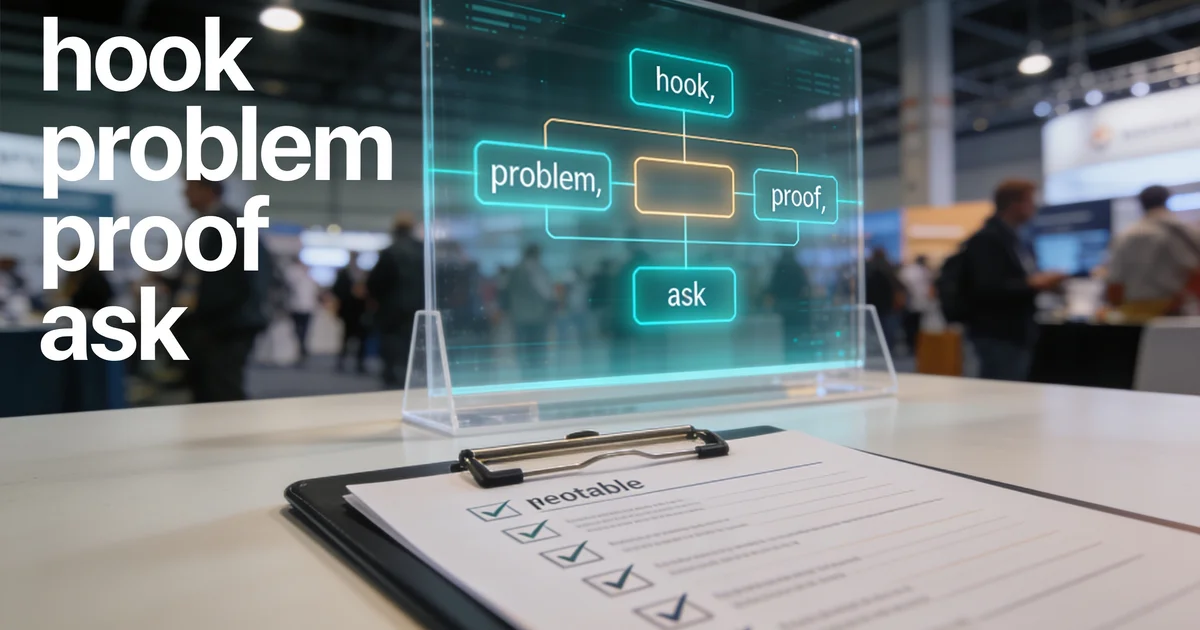
Short answer: The 30-second booth pitch formula is Hook–Problem–Proof–Ask: five seconds to stop the visitor, ten to name their pain, ten for one proof point, five for a clear next step — then hand off to a two-minute qualification script before they walk away.
When I review exhibitor playbooks before show season, the pitch section is almost always missing — or it is a three-page feature list nobody memorizes. Booth teams do not need a TED talk. They need one repeatable story every rep can deliver in half a minute while the aisle keeps moving.
This is the structure we train on at ExhibitionsVoice for B2B booths: Hook–Problem–Proof–Ask, timed to thirty seconds, drilled until it sounds natural, then bridged into qualification. Pair it with a headline that earns the stop — see our booth headline guide — and a CRM workflow that captures what the visitor said — see our lead capture mistakes guide.
The Hook–Problem–Proof–Ask framework
Four beats, one outcome: the visitor knows what you solve, believes you can deliver, and agrees to a next step. No jargon wall. No tour of every SKU.
- Hook (5 seconds) — Outcome or contrast that matches your booth headline. Stop the scroll of their feet.
- Problem (10 seconds) — Name the pain your ICP feels this quarter — not every pain you ever solved.
- Proof (10 seconds) — One metric, one customer type, or one demo moment. Not three case studies.
- Ask (5 seconds) — Low-friction next step: demo, scan, meeting slot, or qualification question.
The pitch is not the close. It is the permission to stay in conversation for two more minutes — covered in our two-minute qualification guide.
Second-by-second timing breakdown
| Segment | Time | Goal | Example cue |
|---|---|---|---|
| Hook | 0:00–0:05 | Earn attention | "Most ops teams still reconcile booth leads manually after every show." |
| Problem | 0:05–0:15 | Mirror ICP pain | "That means hot leads sit in spreadsheets while competitors follow up same day." |
| Proof | 0:15–0:25 | Build credibility | "We helped a mid-market manufacturer cut follow-up time from 72 hours to four." |
| Ask | 0:25–0:30 | Open the next step | "Are you the person who owns post-show follow-up — or should I grab your colleague?" |
If you hit forty-five seconds, you are pitching — not qualifying. Trim proof to one line or move detail into the demo.
Copy-ready script: SaaS / product exhibitor
Use this verbatim for dry runs, then localize numbers and customer type:
Hook: "Teams exhibiting at three or more shows a year usually lose pipeline in the handoff from booth to CRM."
Problem: "Badge scans pile up, notes are blank, and sales re-qualifies from scratch on Monday — so finance asks why you spent six figures on the hall."
Proof: "Our customers typically see complete lead records on 90%+ of scans when staff use a fixed pitch plus three qualification fields — I can show you the workflow on this tablet in ninety seconds."
Ask: "What show are you prepping for next — and who owns follow-up after move-out?"
Product booths live or die on demo discipline: one hero workflow, not every integration. First-time teams should run this script inside the 90/60/30 exhibitor checklist at the 30-day dry-run milestone.
Copy-ready script: Services exhibitor
Services teams often over-explain scope. Keep proof concrete — outcome, timeline, or client type:
Hook: "Most brands hire an agency for booth design but still write aisle copy themselves — and wonder why traffic walks past."
Problem: "Without a single message on the header and a matching thirty-second pitch, staff improvise and every conversation starts differently."
Proof: "We brief agency and client teams on one Hook–Problem–Proof–Ask script before move-in; clients report shorter conversations and more booked meetings on day one."
Ask: "Are you evaluating vendors for your next Tier A show — or building the brief in-house?"
If you hire agency staff to deliver the pitch, the briefing script in our staffing agency guide must include this thirty-second block word-for-word — not a PDF they never read.
Team drill routine (30 days before doors open)
We run this in three sessions; each takes twenty minutes:
- Read-through round — Every rep reads the script aloud once. Circle words that sound unnatural; rewrite once, not ten times.
- Timed rotation — Pairs: one visitor, one rep. Phone timer set to thirty seconds. Reset if proof runs past ten seconds.
- Objection bridge — Visitor says "just looking." Rep delivers hook + ask only: "Totally fair — we help [ICP] with [problem]. Worth ninety seconds if you own [outcome]?"
- Handoff drill — After the ask, rep transitions: "Let me grab two quick details for follow-up" — then runs qualification questions.
- CRM echo — After each drill, rep states aloud the three CRM fields they would log: ICP tier, pain note, next-step owner.
Schedule drills at 30 days out alongside headline approval and scanner testing — same window as our first-time exhibitor checklist. Shortlist which fairs deserve this level of prep on ExhibitionsVoice before you over-invest in a Tier C test show.
Handoff to qualification (do not skip this)
The thirty-second pitch succeeds when it earns a two-minute conversation — not when it exhausts the visitor. Bridge like this:
- Permission: "Can I ask two quick questions so follow-up is useful?"
- Role: "What is your role in [buying area]?"
- Timeline: "Are you evaluating for this quarter or next cycle?"
- Authority: "Who else weighs in besides you?"
- Log before they leave: Notes in CRM within minutes — not on the flight home.
Full qualification flow, polite redirects, and CRM field definitions live in our two-minute qualification guide. Pitch without qualification produces friendly conversations and empty pipeline — the same failure mode we document in lead capture mistakes.
Common booth pitch mistakes
- Feature dump — Listing modules instead of one outcome. Fix: cut proof to a single metric or demo beat.
- Mismatch with headline — Banner says "Cut downtime 40%"; rep talks company history. Fix: hook must echo the header word-for-word.
- No ask — Pitch ends with "so yeah, that's us." Fix: every rep ends with a question that starts qualification.
- Same script for every visitor — Procurement and engineering need different problem lines. Fix: one core script, two problem variants max.
- Pitching past thirty seconds — Aisle backlog; neighboring booths win the next stop. Fix: timer drills until proof is one sentence.
- Agency staff improvising — No briefing doc, no audit. Fix: written script in the agency SOW plus day-one mystery shop.
Where the pitch fits in your 2026 show calendar
Tier A flagships justify script drills, agency briefings, and day-one audits. Tier B regionals need the same structure with a shorter proof line. Tier C tests are where you rewrite the hook — not where you skip the ask. Browse upcoming fairs on ExhibitionsVoice, pick one show to pressure-test the script, and debrief at fourteen days: did booked meetings reference the problem you named in the pitch?
FAQ
What is the 30-second booth pitch formula?
Hook–Problem–Proof–Ask: five seconds to stop the visitor, ten to state their pain, ten for one proof point, five for a next-step question — then transition to qualification.
How long should a trade show booth pitch be?
Thirty seconds for the opening pitch. Demos and deep dives come after qualification confirms ICP fit — not before.
What should you say in a trade show elevator pitch?
Lead with an outcome hook tied to your booth headline, name one problem your buyer recognizes, offer one proof point, and ask a question that starts qualification — not a monologue about company founding.
How do you practice a booth pitch before the show?
Run timed pair drills 30 days out: read-through, thirty-second rotations, objection bridges, and CRM echo after each rep. Match timing to headline and scanner tests on the same checklist.
What are common trade show pitch mistakes?
Feature dumps, headline mismatch, no ask, over-long monologues, and letting agency staff improvise without a written script and day-one audit.
How do you transition from pitch to lead qualification?
End the ask with a permission question — "Can I ask two quick questions for follow-up?" — then role, timeline, and authority. Log CRM fields before the visitor leaves the booth.
Hook–Problem–Proof–Ask timing (5-10-10-5)
| Segment | Time | Goal |
|---|---|---|
| Hook | 5 sec | Outcome or contrast matching booth headline |
| Problem | 10 sec | ICP pain this quarter |
| Proof | 10 sec | One metric, customer type, or demo moment |
| Ask | 5 sec | Next-step question opening qualification |
Team drill routine (30 days out)
- Read-through round — rewrite unnatural phrases once
- Timed pair rotation — phone timer at 30 seconds
- Objection bridge — "just looking" → hook + ask only
- Handoff drill — pitch into two qualification questions
- CRM echo — state three required fields aloud after each drill
Align with 90/60/30 checklist dry run at 30 days.
Handoff to qualification
Bridge: "Can I ask two quick questions so follow-up is useful?" → role, timeline, authority → log CRM before visitor leaves. Full script: qualify a lead in under two minutes.
Common exhibitor questions
What is the 30-second booth pitch formula?
Hook–Problem–Proof–Ask: five seconds to stop the visitor, ten to state their pain, ten for one proof point, five for a next-step question — then transition to qualification.
How long should a trade show booth pitch be?
Thirty seconds for the opening pitch. Demos and deep dives come after qualification confirms ICP fit.
What should you say in a trade show elevator pitch?
Lead with an outcome hook tied to your booth headline, name one problem your buyer recognizes, offer one proof point, and ask a question that starts qualification.
How do you practice a booth pitch before the show?
Run timed pair drills 30 days out: read-through, thirty-second rotations, objection bridges, and CRM echo after each rep.
What are common trade show pitch mistakes?
Feature dumps, headline mismatch, no ask, over-long monologues, and letting agency staff improvise without a written script.
How do you transition from pitch to lead qualification?
End with a permission question, then ask role, timeline, and authority. Log CRM fields before the visitor leaves the booth.
Editorial standards & corrections
This guide is maintained by the ExhibitionsVoice editorial team. We cross-check dates, venues, and organizer names against official sources before listing events. Spot an error? Use our contact form with the event URL and corrected details — every correction request is read by editorial.
Read more: About ExhibitionsVoice · FAQs · All exhibitor guides
Related articles
Oil and gas trade shows 2026: energy calendar and how to pick
Oil and gas trade shows for 2026 — ADIPEC, WETEX, and offshore energy fairs we score for NOC, IOC, and energy-tech exhibitors.
CPHI India 2026 exhibitor guide: Delhi pharma ingredients floor
CPHI India 2026 exhibitor guide for 23-25 November at IICC Yashobhoomi, New Delhi — API, CDMO, and packaging teams scoring South Asia's ingredients floor.

Fintech trade shows 2026: payments calendar and how to pick
Fintech and payments trade shows for 2026 — Money20/20 USA, Sibos, and how banks and vendors pick Tier A/B/C money-ecosystem floors.

ADIPEC 2026 exhibitor guide: Abu Dhabi energy floor
ADIPEC 2026 exhibitor guide for 2-5 November at ADNEC Centre Abu Dhabi — who should exhibit, hall logistics, and how we score the energy floor.