
Article
The anatomy of a great trade show conversation
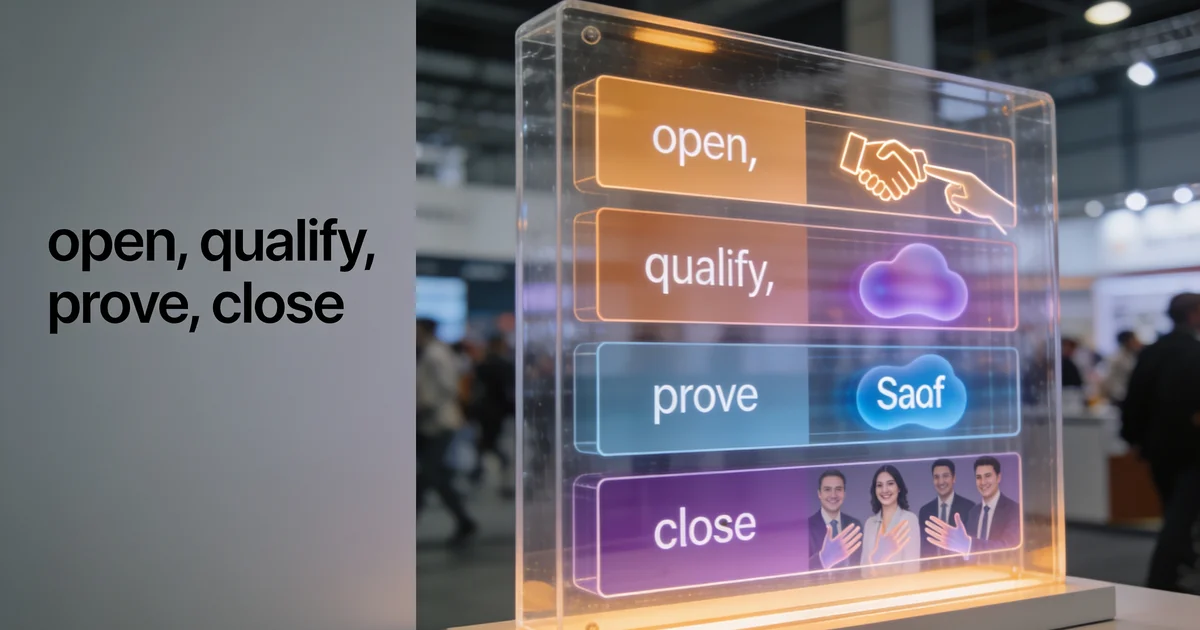
Four phases of a B2B booth conversation — open, qualify, prove, close — with timing, scripts, and handoff cues that turn aisle chats into pipeline.
Article
Short answer: A great B2B trade show conversation follows four timed phases — Open (0–15s), Qualify (15s–2m), Prove (2–4m demo), and Close (meeting ask or tier tag). Each phase has one goal, one owner, and a stop rule. Non-ICP visitors exit at Open or Qualify; warm and hot visitors earn proof and a concrete next step before they leave your carpet.
When I observe booth teams on busy aisles — or review footage in our live booth critique series — the failure is rarely a single bad line. It is missing structure. Reps open with a strong hook but never assign tier. Demo reps prove for eight minutes to someone who cannot sign. Closers ask for meetings before timeline is confirmed. This guide is the full conversation anatomy: timing, scripts per phase, redirect rules, and how it differs from opener lists and qualify-only playbooks you may already have bookmarked.
How this differs from openers and qualify-only scripts
Three resources on ExhibitionsVoice cover slices of the same chain. Use them together — but do not confuse the slice with the whole:
- Conversation starters — ten one-sentence openers for the Open phase only. Pick two per rep; they do not tell you when to demo, redirect, or book.
- Two-minute qualify script — four questions, CRM fields, and hot/warm/cold tiers for the Qualify phase only. It assumes you already earned the first fifteen seconds.
- This anatomy — the end-to-end arc from aisle pause to meeting or tier tag, including when not to prove or close.
The 30-second pitch formula bridges Open into Qualify. The meeting close guide deepens the Close phase. This article is the map that connects those pieces on the floor.
The four-phase timing diagram
Train teams on elapsed time, not vibes. Busy halls compress attention — if you cannot state which phase you are in, the visitor has already mentally left.
| Phase | Time | Goal | Typical owner | Exit if failed |
|---|---|---|---|---|
| Open | 0:00–0:15 | Earn one answer from likely ICP | Qualifier | Polite redirect — no pitch |
| Qualify | 0:15–2:00 | Role, timeline, authority, tier tag | Qualifier | Redirect + cold tag — no demo |
| Prove | 2:00–4:00 | One workflow demo tied to their pain | Demo rep | Shorten proof; skip to Close |
| Close | 4:00–6:00 | Meeting ask or tier-only handoff | Qualifier / AE | CRM complete before exit |
Total target for warm and hot ICP: four to six minutes. Non-ICP stops should finish under forty-five seconds — protecting Prove time for buyers who can actually enter pipeline. Shortlist shows where ICP density supports this discipline on ExhibitionsVoice before you print booth briefings for 2026.
Phase 1: Open (0–15 seconds)
Goal: One answer that signals role, intent, or timeline — not a monologue.
Script (question-led):
"Quick question — are you actively evaluating [solution category] this quarter, or still mapping what good looks like?"
Alternate scripts:
- Pain-led: "Most [ICP role]s tell us [specific pain] spikes after day three — is that on your radar?"
- Event-tied: "What brought you to [show name] — renewal, new vendor search, or benchmarking?"
Pull additional openers from our conversation starters list — this phase is where those lines live. If the visitor keeps walking, do not chase. If they answer but role or industry is clearly off-profile within fifteen seconds, redirect immediately (see non-ICP section) — do not burn Qualify time on a student, job seeker, or vendor scout.
Bridge: On a usable answer, transition to the Hook line from your 30-second pitch — problem and proof in one breath, ending with a qualify question.
Phase 2: Qualify (15 seconds–2 minutes)
Goal: Confirm ICP fit, assign hot/warm/cold, capture CRM hook — before any screen demo.
Script sequence:
- Role — "What do you own day to day — and who else weighs in when you change vendors?"
- Timeline — "Are you buying this quarter, or building the case for next year's budget?"
- Current state — "What are you using today — and what would make you switch?"
Full question order, CRM required fields, and scanner workflow live in our two-minute qualify guide — this phase is where that script runs inside the larger arc. Tag tier on the tablet before minute two. Warm and hot tiers hand off to Prove; cold tiers redirect without demo.
Stop rule: If timeline is vague, pain is generic, and authority path is missing after two minutes, assign warm at best — do not enter Prove on hope. Protect demo rep capacity for buyers with eval signals.
Phase 3: Prove (2–4 minutes)
Goal: Show one workflow that maps to the hook sentence captured in Qualify — not a feature tour.
Script (demo rep):
"You mentioned [their hook — e.g., SAP integration at renewals]. I'll show the ninety-second version of how teams like yours handle that — stop me if it does not match your stack."
Prove phase rules I enforce on booths we advise:
- One workflow, one screen — resist the "while I'm here" feature pile-on.
- Qualifier stays on CRM — tier, hook, and next-step fields update while demo rep maintains eye contact.
- Check at 3:30 — "Does this match the problem you described, or should we adjust?" — buyer-led correction beats silent nodding.
- Hot signal shortcut — if they ask pricing or pull a colleague mid-demo, skip remaining proof and move to Close.
Past four minutes without a Close attempt, you are subsidizing consulting. Peak-hour aisles punish long tours — the anatomy keeps proof bounded so Close still happens before they drift to the giveaway three booths down.
Phase 4: Close (meeting ask or tier tag)
Goal: Concrete next step matched to tier — not every conversation earns a calendar invite.
Hot tier — meeting ask script:
"For a thirty-minute deep dive on [hook], I have Tuesday at 2pm or Thursday at 10am with [AE name] — which works better?"
Warm tier — calendar link + tag:
"I'll text you my calendar — grab any thirty-minute slot next week. I'm tagging your account so [AE] sees the [hook] note before the call."
Cold tier — tier tag only: No meeting ask. Confirm nurture path: "I'll send the public guide on [topic] — wrong booth for a live demo, but your [role] colleague might find us on row [X]."
Hot and warm close mechanics — two-time vs calendar link, demo handoff cues, same-day booking — are expanded in our conversation-to-meeting guide. Close phase ends when CRM shows tier, hook, next step, and owner — not when the visitor says "sounds good."
When to redirect non-ICP visitors
Redirect is a phase decision, not rudeness. Exit at Open or Qualify — never after Prove starts.
Redirect triggers:
- Role or industry outside ICP after first answer
- Student, job seeker, or press with no buying brief
- Competitor scout fishing for pricing with no eval context
- Timeline "never" or "just browsing" with no pain validated
- Refusal to answer role or authority after two qualify questions
Redirect script:
"Thanks for stopping by — we focus on [ICP segment]. Here is a guide that might help your team. If your [buyer role] colleague is on the floor, send them over — the live demo is built for their workflow."
Tag cold if house-list rules require a scan; otherwise skip the scan. Offer swag after the redirect line, not as the opener. Every minute saved on non-ICP is a minute available for hot Close on day three — the pattern we flag when critiquing real booth footage in our live booth critique series.
Train the full arc before move-in
- Print the timing diagram on the booth back wall — phase names and stop rules at eye level.
- Assign phase owners — qualifier on Open and Qualify; demo rep on Prove; AE joins Close for hot tier.
- Rehearse with a timer — opener at 0:15, tier tag by 2:00, proof done by 4:00, CRM complete by 6:00.
- Role-play redirect — teammate plays job seeker; rep must exit before Prove, not demo out of guilt.
- Debrief by phase — post-show, count where conversations died (Open drop, qualify stall, prove overrun, close miss). Phase-level debrief beats "we need more traffic" when the anatomy was never trained.
Pick shows where your ICP actually walks the hall — browse B2B listings on ExhibitionsVoice — then invest training hours in this arc. A perfect talk track at the wrong fair still produces empty pipeline.
FAQ
What are the four phases of a trade show booth conversation?
Open (0–15s), Qualify (15s–2m), Prove (2–4m demo), and Close (meeting ask or tier tag). Each phase has one goal, a time ceiling, and a named owner on the booth team.
How is this different from a conversation starter list?
Starter lists cover only Open — one sentence to earn an answer. This anatomy maps the full arc through qualification, bounded proof, and tier-appropriate close with explicit redirect rules between phases.
How long should a great trade show conversation last?
Four to six minutes for warm and hot ICP visitors. Non-ICP redirects should finish under forty-five seconds. Past six minutes without CRM complete, you are likely over-proving to the wrong buyer.
When should you redirect a visitor who is not ICP?
During Open or Qualify — as soon as role, industry, budget path, or timeline fails ICP criteria. Do not enter Prove for non-buyers; tag cold and offer a public resource instead of a demo.
Should every qualified conversation end with a meeting ask?
No. Hot tier gets a meeting ask with two specific times. Warm tier gets a calendar link and tier tag. Cold tier gets tier tag and nurture handoff only — pushing meetings on cold tiers burns domain reputation post-show.
Who runs each phase at the booth?
Qualifier owns Open and Qualify. Demo rep owns Prove. Qualifier or AE owns Close depending on tier. Minimum two trained reps on any booth expecting pipeline; rotate hourly on peak days.
The four-phase timing diagram
| Phase | Time | Goal | Owner |
|---|---|---|---|
| Open | 0:00–0:15 | Earn one answer from ICP | Qualifier |
| Qualify | 0:15–2:00 | Role, timeline, authority, tier tag | Qualifier |
| Prove | 2:00–4:00 | One workflow demo tied to their pain | Demo rep |
| Close | 4:00+ | Meeting ask or tier-only handoff | Qualifier + AE |
Not a starter list — see conversation starters for opener options. Not qualify-only — see two-minute qualify script for CRM fields.
Phase 1: Open (0–15 seconds)
Script: "Quick question — are you evaluating [category] this quarter, or mapping options for next year?"
Bridge to 30-second pitch if they answer. Redirect non-ICP within 15s if role or industry is clearly off-profile.
Phase 2: Qualify (15 seconds–2 minutes)
Run role, timeline, authority, current vendor. Assign hot/warm/cold before minute two. Non-ICP redirect here — do not enter Prove phase.
Phase 3: Prove (2–4 minutes)
One workflow demo mapped to their hook sentence — not a feature tour. Demo rep owns; qualifier stays on CRM.
Phase 4: Close (meeting ask or tier tag)
Hot: two specific times via meeting close scripts. Warm: calendar link + tier tag. Cold: tier tag only — no meeting ask.
When to redirect non-ICP visitors
Redirect at Open or Qualify boundary — wrong role, no budget path, student/job seeker, or competitor scout. Polite script + cold tier; skip Prove and Close meeting ask.
Common exhibitor questions
What are the four phases of a trade show booth conversation?
Open (0–15s), Qualify (15s–2m), Prove (2–4m demo), and Close (meeting ask or tier tag). Each phase has a distinct goal and owner on the booth team.
How is this different from conversation starter lists?
Starter lists cover only the Open phase — one sentence to earn an answer. This anatomy maps the full arc through qualification, proof, and close with timing boundaries.
How long should a great trade show conversation last?
Target four to six minutes for warm and hot ICP visitors: under 15 seconds to open, under two minutes to qualify, two to four minutes to prove, then close. Non-ICP stops should end under 45 seconds.
When should you redirect a visitor who is not ICP?
During Open or Qualify — as soon as role, industry, or budget path fails ICP criteria. Do not run a demo for non-buyers; tag cold and offer a public resource instead.
Should every conversation end with a meeting ask?
No. Hot tier gets a meeting ask. Warm tier gets a calendar link and tier tag. Cold tier gets tier tag and nurture handoff only — no meeting push.
Who runs each phase at the booth?
Qualifier owns Open and Qualify; demo rep owns Prove; qualifier or AE owns Close depending on tier. Two trained reps minimum on any pipeline booth.
Editorial standards & corrections
This guide is maintained by the ExhibitionsVoice editorial team. We cross-check dates, venues, and organizer names against official sources before listing events. Spot an error? Use our contact form with the event URL and corrected details — every correction request is read by editorial.
Read more: About ExhibitionsVoice · FAQs · All exhibitor guides
Related articles
Oil and gas trade shows 2026: energy calendar and how to pick
Oil and gas trade shows for 2026 — ADIPEC, WETEX, and offshore energy fairs we score for NOC, IOC, and energy-tech exhibitors.
CPHI India 2026 exhibitor guide: Delhi pharma ingredients floor
CPHI India 2026 exhibitor guide for 23-25 November at IICC Yashobhoomi, New Delhi — API, CDMO, and packaging teams scoring South Asia's ingredients floor.
Fintech trade shows 2026: payments calendar and how to pick
Fintech and payments trade shows for 2026 — Money20/20 USA, Sibos, and how banks and vendors pick Tier A/B/C money-ecosystem floors.
ADIPEC 2026 exhibitor guide: Abu Dhabi energy floor
ADIPEC 2026 exhibitor guide for 2-5 November at ADNEC Centre Abu Dhabi — who should exhibit, hall logistics, and how we score the energy floor.