
Article
Trade show signs: aisle hierarchy, materials, and print specs (2026)
Signage that works from the aisle — hierarchy, materials, hanging vs fascia, and the print deadlines we use before 2026 show move-in.

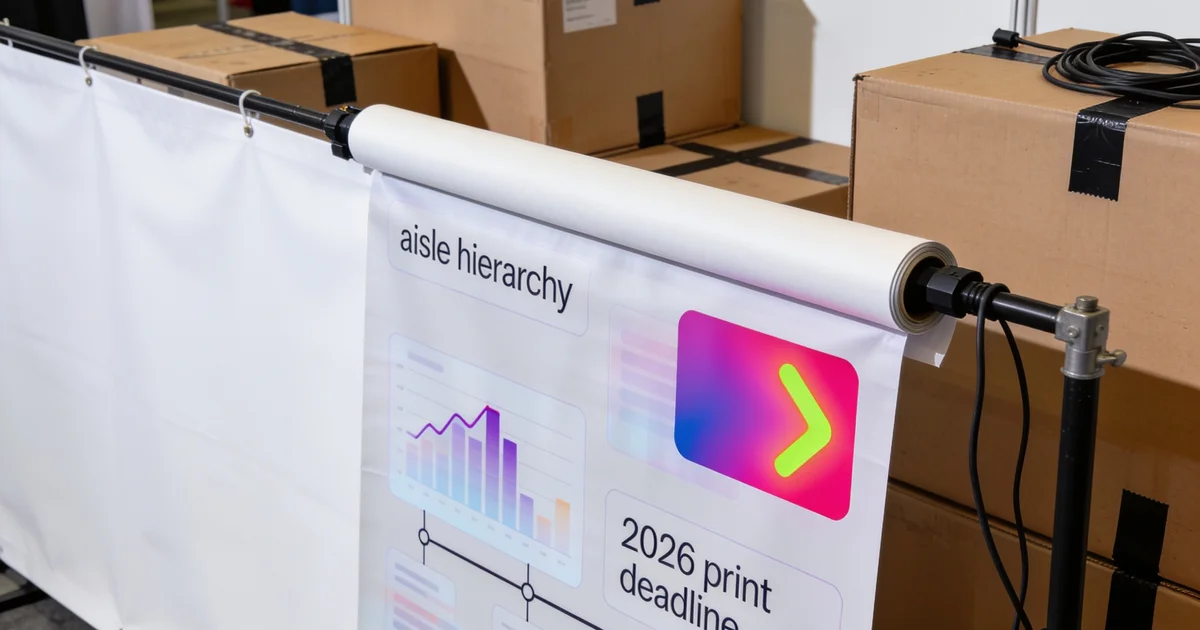
Article
Short answer: Trade show signs work in 2026 when they create a clear aisle hierarchy: one distance-readable promise, one proof layer, and one next-step cue. The right mix may include hanging signs, fascia signs, fabric backwalls, directional floor graphics, counter signs, and demo labels, but the goal is not more signage. The goal is faster buyer comprehension without blocking the booth or triggering late print and rigging costs.
When I audit a booth before move-in, signage is usually the easiest thing to overbuy and the hardest thing to fix late. Teams add banners because they are cheaper than redesigning the stand, then wonder why the booth feels noisy. Good trade show signs do a simple job: help the right buyer understand who we help, what outcome we create, where to look, and what to do next.
The signage hierarchy we use
I divide trade show signs into three layers. The distance layer is the promise: the buyer outcome visible from the aisle or across the hall. The proof layer explains why the claim is credible: customer segment, metric, demo object, or product category. The action layer tells visitors where to engage: see demo, scan agenda, book meeting, pick up sample, or speak to a specialist.
Most booths fail because every sign tries to do every job. A hanging sign should not carry a paragraph. A counter sign should not repeat the exact same logo the visitor has already seen three times. A demo label should not become a spec sheet. We assign one job per sign and cut everything else.
Trade show sign types and cost ranges
The right sign depends on booth size, ceiling rules, show tier, and installation deadlines. These are planning ranges I use before supplier quotes.
| Sign type | Best use | 2026 planning range | Watch-outs |
|---|---|---|---|
| Retractable banner | Small booth support, sponsor areas | $150-$800 each | Weak as main booth architecture; can clutter entry |
| Fabric backwall graphic | 10x10 or portable booth promise | $600-$3,500 | Needs precise print file and strong contrast |
| Foam board / rigid panel | Demo labels, product proof, counter signage | $75-$500 each | Looks cheap if overused or poorly mounted |
| Hanging sign | Large island or crowded hall visibility | $3,000-$20,000+ with rigging | Rigging approvals and labour can exceed print cost |
| Floor graphics | Directional cues, queue management | $300-$2,500 | Venue approval, cleaning, and removal rules |
| Digital sign / monitor loop | Demo motion and rotating proof | $500-$5,000+ rental or purchase | Electrical, mounting, brightness, and content prep |
These are sign costs, not total exhibit costs. Every signage plan still sits inside the full budget model from our cost to exhibit at a trade show guide and average trade show booth cost breakdown.
Match signage to booth format
For a 10x10 booth, I usually want one strong backwall, one counter or demo sign, and maybe one small directional or QR sign. More than that often creates clutter. If the booth uses a pop-up or portable kit, the main wall has to carry the message cleanly. Our pop-up trade show booth guide and portable trade show displays guide explain how small-booth graphics should stay disciplined.
For a 10x20 or modular stand, signage can guide zones: demo, meeting, product, partner, or hospitality. The danger is repeating the same headline on every panel. I prefer one primary promise and then zone-specific proof. For London and other European events, modular structures may give signage a cleaner frame, which is why we compare options in our modular exhibition stand hire London guide.
For islands, hanging signs can help buyers find us from a distance, but they are not automatic. Rigging, engineering, labour, and height rules can turn a simple sign into a major line item. If the hanging sign only repeats a logo, I question the spend. If it anchors a clear category promise at a flagship show, it may be worth it.
Messaging rules: what the sign should say
Our main trade show sign follows a short formula: buyer segment plus outcome, in language a real person would say. "AI-enabled enterprise workflow optimisation platform" is not a sign. "Cut field service downtime before it hits SLA" is closer. The buyer should know whether to stop without asking our staff to decode the wall.
I use three copy checks. First, can the headline be read at walking speed? Second, does the proof line make the claim believable? Third, does the action cue tell the visitor what happens next? If the answer is no, we rewrite before we print. Signs are too visible to carry committee language.
| Layer | Good sign copy | Weak sign copy |
|---|---|---|
| Distance promise | Reduce equipment downtime in 30 days | Industrial IoT Platform Suite |
| Proof layer | Used by 400+ maintenance teams | Innovative, scalable, future-ready |
| Action cue | See the live fault dashboard | Learn more |
Materials and print specs that prevent mistakes
We choose material based on use, not habit. Fabric works for large backwalls because it travels well and looks softer under hall lighting. Rigid panels work for demo labels and product zones. Vinyl can work for floors and temporary direction, but only if the venue approves adhesive and removal. Digital screens work when motion matters, but content needs to be designed for silent viewing.
Before printing, we confirm dimensions, bleed, safe area, colour profile, file format, mounting method, and lighting. I also ask who will physically install each sign. A beautiful panel is useless if nobody brought the correct hardware or the venue requires official labour to mount it.
Deadline plan and rush-fee control
Signage is where late decisions become expensive. I want final copy approved before design lock, print files delivered before the supplier's standard deadline, and onsite copies packed separately from the main case when they are critical. If we are still debating a headline one week before freight pickup, the problem is strategy, not production.
For international events, print decisions get even sharper. Shipping signs across borders can be foolish when local print is reliable, but local print needs colour control and proofing. In Dubai or GCC contexts, I compare the signage and stand plan against our Dubai exhibition stand design cost guide before assuming the home-market supplier is best.
Where signage fits in the booth budget
Signage should support the booth strategy, not consume budget that should go to meetings, demos, or follow-up. For a small regional show, $1,500-$5,000 in signs may be plenty. For a flagship island, signage and rigging can become a serious investment, but only if the show tier justifies it. We confirm that with our show budget selection guide and then decide whether to rent, buy, or build assets using the rent-or-buy booth guide.
Before any large print or rigging order, we check the event fit on ExhibitionsVoice trade shows so signage spend matches the hall and audience. My rule is simple: every sign must earn its square footage. If it does not improve visibility, proof, navigation, or conversion, it is decoration. Decoration is the first thing I cut when the budget tightens.
FAQ
What signs do I need for a trade show booth?
Most booths need one main distance-readable sign, one proof or demo sign, and one action cue. Larger booths may add hanging signs, zone labels, floor graphics, or digital screens, but only when each sign has a specific job.
How much do trade show signs cost in 2026?
Retractable banners can cost $150-$800, fabric backwall graphics $600-$3,500, rigid panels $75-$500, hanging signs $3,000-$20,000+ with rigging, and digital signage $500-$5,000+ depending on rental or purchase.
Are hanging signs worth it at trade shows?
Hanging signs are worth it for large booths in crowded halls when the sign carries a clear category or outcome promise. They are usually not worth it when they only repeat the logo and trigger rigging costs without improving buyer comprehension.
What should a trade show sign say?
The main sign should state the buyer outcome in plain language. Supporting signs should add proof, direct visitors to demos, or explain the next step. Avoid long paragraphs, vague adjectives, and internal product language.
When should trade show signs be printed?
I want final copy and files ready at least 2-3 weeks before freight pickup for standard signs, earlier for hanging signs, international shipments, or complex installs. Late signage creates rush fees and avoidable quality mistakes.
What material is best for trade show signs?
Fabric works well for backwalls, rigid panels for demos and product zones, vinyl for approved floor graphics, and digital screens for motion. The best material depends on booth format, lighting, mounting, and venue rules.
The signage hierarchy we use
Define distance promise, proof layer, and action cue. Explain why each sign should have one job rather than repeating logos or paragraphs.
Trade show sign types and cost ranges
Include retractable banners, fabric backwalls, rigid panels, hanging signs, floor graphics, and digital signs with 2026 planning ranges and watch-outs.
Materials and print specs that prevent mistakes
Cover fabric, rigid panels, vinyl, digital screens, bleed, safe area, colour profile, mounting, lighting, and who physically installs each sign.
Common exhibitor questions
What signs do I need for a trade show booth?
Most booths need one main distance-readable sign, one proof or demo sign, and one action cue. Larger booths may add hanging signs, zone labels, floor graphics, or digital screens.
How much do trade show signs cost in 2026?
Retractable banners can cost $150-$800, fabric backwalls $600-$3,500, rigid panels $75-$500, hanging signs $3,000-$20,000+ with rigging, and digital signage $500-$5,000+.
Are hanging signs worth it at trade shows?
They are worth it for large booths in crowded halls when they carry a clear category or outcome promise. They are weak investments when they only repeat the logo.
What should a trade show sign say?
The main sign should state the buyer outcome in plain language. Supporting signs should add proof, direct visitors to demos, or explain the next step.
When should trade show signs be printed?
Final copy and files should be ready at least 2-3 weeks before freight pickup, earlier for hanging signs, international shipments, or complex installs.
Editorial standards & corrections
This guide is maintained by the ExhibitionsVoice editorial team. We cross-check dates, venues, and organizer names against official sources before listing events. Spot an error? Use our contact form with the event URL and corrected details — every correction request is read by editorial.
Read more: About ExhibitionsVoice · FAQs · All exhibitor guides
Related articles
Oil and gas trade shows 2026: energy calendar and how to pick
Oil and gas trade shows for 2026 — ADIPEC, WETEX, and offshore energy fairs we score for NOC, IOC, and energy-tech exhibitors.

CPHI India 2026 exhibitor guide: Delhi pharma ingredients floor
CPHI India 2026 exhibitor guide for 23-25 November at IICC Yashobhoomi, New Delhi — API, CDMO, and packaging teams scoring South Asia's ingredients floor.

Fintech trade shows 2026: payments calendar and how to pick
Fintech and payments trade shows for 2026 — Money20/20 USA, Sibos, and how banks and vendors pick Tier A/B/C money-ecosystem floors.

ADIPEC 2026 exhibitor guide: Abu Dhabi energy floor
ADIPEC 2026 exhibitor guide for 2-5 November at ADNEC Centre Abu Dhabi — who should exhibit, hall logistics, and how we score the energy floor.