
Article
Trade show booth banners: sizes, materials, and messaging that works (2026)
Banner and pull-up choices for B2B booths — sizes, materials, print specs, and messaging hierarchy that reads from the aisle in 2026 halls.

Article
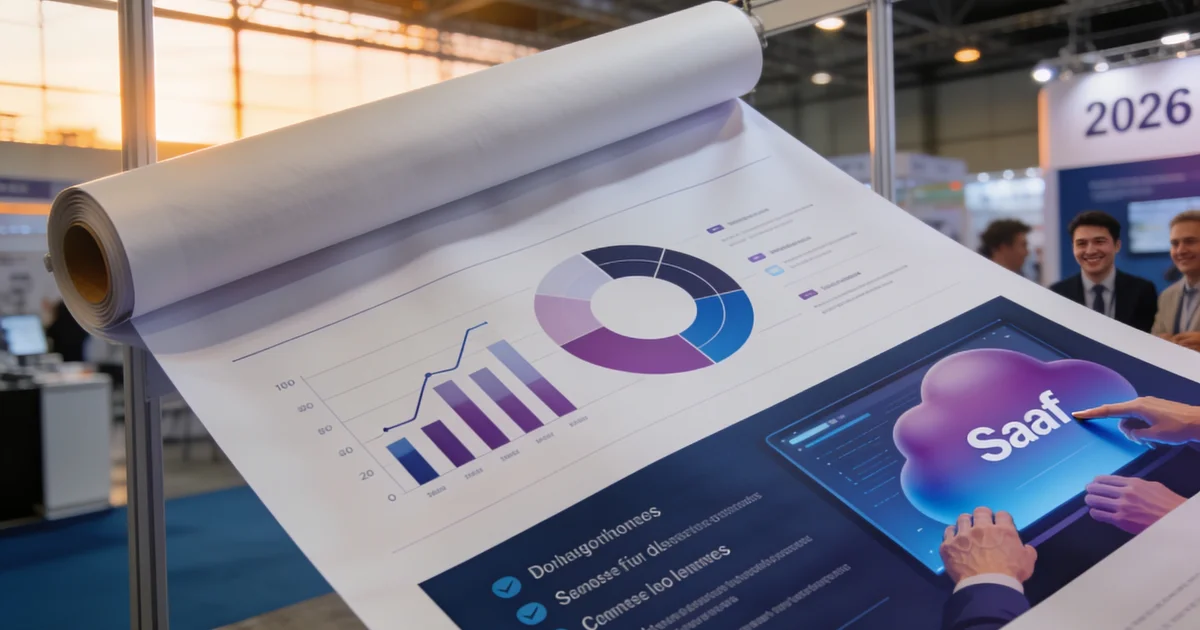
Short answer: A trade show booth banner should make one buyer outcome readable from the aisle, support the booth's main display, and fit the footprint without blocking entry. For 2026, the most useful options are retractable pull-up banners, fabric backwall banners, tabletop signs, and overhead or hanging banners where venue rules allow. Choose size and material after you know the message hierarchy and booth layout.
I see banners fail for a predictable reason: they are ordered as print assets, not as traffic tools. A banner is not a portable brochure. It has seconds to tell a moving visitor whether your booth is relevant. If it tries to show your logo, full product range, awards, QR code, partner list, and six claims, it becomes visual noise. I would rather see one sharp banner that supports the sales conversation than three generic signs that make the booth harder to read.
What a trade show booth banner should do
A booth banner has three jobs. First, identify the outcome or category for the right visitor. Second, point attention toward the booth's proof: demo, product, sample, meeting point, or offer. Third, reinforce credibility without overwhelming the main display. That is all. If the banner is carrying every marketing message, the booth design brief is not focused enough.
Banners work best as part of a system. A retractable banner beside a demo counter can introduce the proof. A fabric backwall banner can replace a heavier display in a lean 10x10. A hanging banner can help visitors find a large island from a distance, but it still needs floor-level messaging once they arrive. For the larger system, read our trade show booth displays guide and our booth design guide.
CEIR has often reported that booth space can represent about 25-35% of total exhibiting budget. Banners are a small line item by comparison, which is why teams sometimes order them casually. But a cheap banner with the wrong message can make a costly booth less effective. Treat the banner as a conversion surface, not a leftover print request.
Common banner types and sizes
| Banner type | Common size range | Best use | Watch-out |
|---|---|---|---|
| Retractable pull-up banner | Approx. 24-36 inches wide by 72-84 inches tall | Portable 10x10 booths, demo support, directional message | Too much text makes it unreadable while walking |
| Fabric backwall banner | 8-10 feet wide for small booths; larger for modular frames | Main backdrop, outcome headline, product category clarity | Wrinkles, weak lighting, or low contrast reduce impact |
| Tabletop or counter sign | Small format, often under 24 inches | QR code, offer, meeting booking, sample label | Should not carry the primary headline |
| Hanging banner | Varies by venue and rigging rules | Island identification from long distance | Requires approval, rigging cost, and floor-level support |
| Outdoor or entry banner | Venue-specific | Sponsorship, registration path, hosted event visibility | Organizer rules and weather-rated materials matter |
Exact sizes depend on the booth system and organizer rules. Always confirm the display frame, finished graphic dimensions, bleed, safe area, grommets, pole pockets, and fire-rating requirements before printing. A banner that is almost the right size is still a problem at move-in.
Material choices
Vinyl is durable, affordable, and familiar, but it can glare under hall lights and look heavy if the design is crowded. Fabric travels well, photographs cleaner, and works nicely for backwalls, but it needs proper tension and care to avoid wrinkles. Mesh is useful for certain outdoor or airflow situations, but it is rarely the first choice for indoor B2B booth messaging. Rigid signs or foam boards can support counters and product labels, but they are not replacements for the main visual hierarchy.
For repeat exhibitors, I care as much about cases and replacement workflow as material. Can the banner survive freight? Can staff set it up without tools? Can you replace only the printed graphic when the message changes? Can it be packed without crushing product samples? These operational details matter more after the first show than the online product description suggests.
If the banner is part of a kit you may reuse, compare the economics with our rent-or-buy guide. If it is part of a broader first-time budget, use the exhibiting cost guide and average booth cost breakdown so printing does not get planned in isolation.
Message hierarchy for booth banners
The primary banner line should answer a buyer question, not simply name your company. "Industrial IoT Solutions" is a category label. "Reduce unplanned downtime across remote assets" is closer to a reason to stop. Keep the headline short enough to read at aisle speed. Use a support line for segment, proof, or scope. Put QR codes, booth numbers, and secondary claims lower, where interested visitors can engage after they have stopped.
| Banner layer | Recommended content | Design note |
|---|---|---|
| Top third | Buyer outcome or specific category | Largest type, highest contrast, shortest wording |
| Middle third | Product proof, demo invitation, or segment fit | One idea, not a paragraph |
| Lower third | QR code, URL, booth number, meeting prompt | Useful after the visitor stops |
Do not put the main QR code at eye level if it competes with the headline. A QR code should support the next step, not become the message. If you need people to book meetings, say that plainly and connect the scan to a useful action.
Placement by booth size
10x10 booth banners
In a 10x10, one backwall or one pull-up is usually enough. Too many vertical banners create a fence. Keep the entry open, angle the pull-up slightly toward traffic if it supports a demo, and avoid blocking staff sight lines. The full footprint guidance is in our 10x10 trade show booth guide.
10x20 and inline booths
Use banners to separate product zones without building walls. One banner can introduce the demo, another can identify a secondary category, but the hierarchy must still feel like one booth. Repeating the logo on every surface is not a message strategy.
Island booths
Hanging banners can help long-distance visibility, but each aisle face needs its own readable floor-level cue. Visitors approaching from the side should not have to walk around the booth to understand the offer. Think of the banner as identification; the booth edge still has to convert.
Print and production checklist
- Confirm dimensions: Finished size, bleed, safe area, frame specs, and orientation.
- Check material: Vinyl, fabric, rigid, mesh, flame rating, glare, and wrinkle risk.
- Test readability: Print a scaled proof and judge the headline from walking distance.
- Protect contrast: Hall lighting is rarely kind to low-contrast type.
- Pack replacements: Bring repair tape, spare hardware if possible, and digital print files.
- Match the booth plan: Banner placement should support the layout in the visitor-intent design guide.
- Plan follow-up: If a banner drives scans or meeting requests, route them into post-event follow-up immediately.
If you are still deciding which shows deserve banner and booth spend, start with the ExhibitionsVoice trade show directory and the B2B show selection guide. If your company serves exhibitors and wants visibility during planning cycles, review the ExhibitionsVoice media pack.
Common banner mistakes
The first mistake is using a banner as a brochure. Too many bullets, icons, photos, partner logos, and claims create a surface nobody reads. The second mistake is placing banners where staff or furniture block them. The third is ordering a generic pull-up for every show even when the audience changes. The fourth is printing too late, which invites rushed proofing and expensive corrections.
My fix is simple: write the headline first, choose the booth position second, then decide the banner type. If the message does not earn its space, do not print it. A booth with fewer, clearer banners almost always looks more confident than one covered in disconnected signs.
FAQ
What size should a trade show booth banner be?
For small booths, retractable banners are often about 24-36 inches wide and 72-84 inches tall, while backwall banners commonly span 8-10 feet. Exact dimensions depend on the frame, booth package, and organizer rules.
What should I put on a trade show banner?
Use one buyer outcome or category headline, one support proof or demo invitation, and a clear next step such as a meeting link or QR code. Avoid turning the banner into a full product brochure.
Are retractable banners good for trade shows?
Yes, retractable banners are useful for portable 10x10 booths, demo cues, and lean regional events. They work best when the message is short, high contrast, and placed where the banner does not block entry.
What material is best for trade show banners?
Fabric often looks cleaner for backwalls and travels well when tensioned properly. Vinyl is durable and affordable but can glare. The best material depends on booth use, lighting, freight, frame system, and reuse plan.
How many banners should I use in a 10x10 booth?
Usually one strong backwall or one supporting pull-up is enough. More banners can make a small booth feel blocked and noisy. Prioritize a readable main message and open entry.
Do banners replace a full booth display?
No. Banners are part of the display system. They can support a portable booth or communicate a focused message, but they do not replace layout, demo planning, lighting, staffing, and lead follow-up.
What a trade show booth banner should do
Editorial coverage for banner for trade show booth — practical criteria, budget context, and directory-backed planning for 2026 exhibitors. See the full article body for tables and FAQs.
Common banner types and sizes
Editorial coverage for banner for trade show booth — practical criteria, budget context, and directory-backed planning for 2026 exhibitors. See the full article body for tables and FAQs.
Material choices
Editorial coverage for banner for trade show booth — practical criteria, budget context, and directory-backed planning for 2026 exhibitors. See the full article body for tables and FAQs.
Message hierarchy for booth banners
Editorial coverage for banner for trade show booth — practical criteria, budget context, and directory-backed planning for 2026 exhibitors. See the full article body for tables and FAQs.
Common exhibitor questions
What should I budget for banner for trade show booth?
Budget depends on footprint, show tier, and whether you rent, buy portable, or commission custom. Use our all-in exhibit cost guide and booth cost breakdown for ranges.
How do I choose the right option for banner for trade show booth?
Match format to show frequency, brand requirements, and freight constraints. Multi-show calendars usually favor modular or owned portable systems.
Where do I find shows to exhibit at?
Browse the ExhibitionsVoice trade show directory and city hubs, then confirm dates on the organizer site before you book space.
Editorial standards & corrections
This guide is maintained by the ExhibitionsVoice editorial team. We cross-check dates, venues, and organizer names against official sources before listing events. Spot an error? Use our contact form with the event URL and corrected details — every correction request is read by editorial.
Read more: About ExhibitionsVoice · FAQs · All exhibitor guides
Related articles
Oil and gas trade shows 2026: energy calendar and how to pick
Oil and gas trade shows for 2026 — ADIPEC, WETEX, and offshore energy fairs we score for NOC, IOC, and energy-tech exhibitors.

CPHI India 2026 exhibitor guide: Delhi pharma ingredients floor
CPHI India 2026 exhibitor guide for 23-25 November at IICC Yashobhoomi, New Delhi — API, CDMO, and packaging teams scoring South Asia's ingredients floor.

Fintech trade shows 2026: payments calendar and how to pick
Fintech and payments trade shows for 2026 — Money20/20 USA, Sibos, and how banks and vendors pick Tier A/B/C money-ecosystem floors.
ADIPEC 2026 exhibitor guide: Abu Dhabi energy floor
ADIPEC 2026 exhibitor guide for 2-5 November at ADNEC Centre Abu Dhabi — who should exhibit, hall logistics, and how we score the energy floor.