
Article
How to train your booth staff in one hour
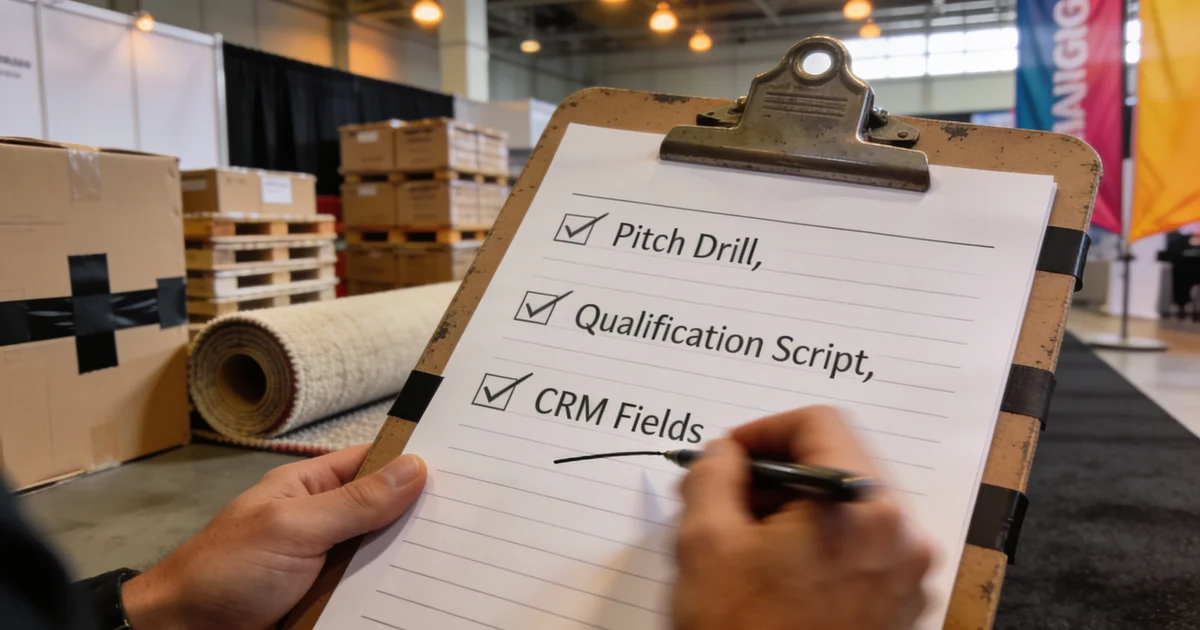
A one-hour booth staff training agenda — pitch drill, qualification script, CRM fields, and escalation rules — so any team member can run the aisle before doors open.
Article
Short answer: Train booth staff in one hour with five timed blocks — 0–10 pitch drill, 10–25 qualification script, 25–40 CRM demo, 40–50 role-play, 50–60 escalation rules — so every aisle rep can deliver the same 30-second opener, tag hot/warm/cold, log required CRM fields, and hand off hot leads before doors open.
When I audit exhibitor teams before major B2B fairs, the failure mode is rarely talent — it is the absence of a single timed briefing. Marketing emails a deck; sales assumes product knowledge equals booth skill; day one produces friendly conversations and empty CRM hooks. This guide is the one-hour huddle I require before any 2026 booth we advise on goes live: minute-by-minute agenda, what to say, what to demo on a tablet, and how to differentiate training your own team from hiring strangers through an agency.
Train your team — not the same as hiring agency staff
This page is for briefing people you already employ — sales reps, SEs, founders, customer success — or specialists who will own pipeline after move-out. It is the compressed version of the pitch, qualify, and capture playbooks we publish separately; it is not a vendor selection guide.
If you are deciding whether to rent brand ambassadors because internal headcount cannot cover peak hours, read our trade show staffing agency guide first. That article covers cost bands, briefing SOW language, and day-one mystery shops for temp staff. Come back here to run the same script on your own team — and require agency hires to sit through this huddle on setup day before they touch the aisle.
Shortlist which fairs deserve a full one-hour drill versus a lighter Tier C test on ExhibitionsVoice before you block calendar time. Pipeline booths get the full hour; validation booths can run a 30-minute pitch-plus-qualify subset.
The 60-minute booth staff training agenda
One facilitator, one room (or the back of the booth on setup day), one shared tablet logged into CRM. No slides unless the pitch script fits on a single printed card. The table below is the run-of-show — stick to the clock or qualification quality collapses on hour three of day one.
| Minutes | Block | Facilitator action | Rep outcome |
|---|---|---|---|
| 0–10 | Pitch drill | Read Hook–Problem–Proof–Ask once; timed pair rotations | Every rep delivers a 30-second pitch without a feature dump |
| 10–25 | Qualify script | Teach four questions + hot/warm/cold tiers; polite redirect line | Rep can tag tier before inviting a demo |
| 25–40 | CRM demo | Live entry on booth tablet: scan, fields, backup path | Every rep completes one mock hot lead record |
| 40–50 | Role-play | Three scenarios: hot buyer, vague browser, wrong persona | Rep handles redirect without rudeness or over-demo |
| 50–60 | Escalation | Named owners, Slack channel, manager handoff rules | Rep knows who to ping and when to stop qualifying |
Schedule this huddle during the staffing milestone in our ultimate booth setup walkthrough — after scanner offline tests, before the aisle opens. A briefing in the hotel lobby without hardware is theatre.
Block 1 (0–10): Pitch drill
Open with the 30-second booth pitch formula — Hook–Problem–Proof–Ask, five / ten / ten / five seconds. Print one script on badge clips; do not distribute a ten-page battle card.
- 0:00–0:03 — Facilitator reads the script aloud once while reps follow on paper.
- 0:03–0:08 — Pairs: visitor and rep, phone timer set to thirty seconds. Reset if proof runs past ten seconds.
- 0:08–0:10 — Whole group states the ask line together — the question that earns the next two minutes of qualification.
Common fix in this block: reps who open with company founding year. Cut to the hook that matches your booth header. Mismatch between banner and mouth is the fastest way to lose aisle stops.
Block 2 (10–25): Qualification script
Transition: "The pitch buys you ninety seconds — here is how we use them." Teach the four questions from our two-minute qualification guide in order:
- Role — "What is your role, and what do you own day to day?"
- Timeline — "Are you evaluating anything this quarter, or planning for next year?"
- Authority / budget — "When you change vendors or approve spend, who else weighs in?"
- Current vendor — "What are you using today — and what would make you switch?"
Assign tiers at the booth, not at debrief:
- Hot — ICP match, timeline under ninety days, budget path clear, next step agreed.
- Warm — ICP fit, pain validated, no immediate project — personalized follow-up within twenty-four hours.
- Cold — wrong persona or minimal conversation — polite redirect, no fifteen-minute demo.
Spend the last five minutes of this block on the redirect line for non-ICP visitors. Protecting rep energy on day three matters as much as catching hot buyers on day one.
Block 3 (25–40): CRM demo on the booth tablet
Move from script to muscle memory. Open the same scanner app or CRM mobile view you will use on the floor — walkthrough aligned with our lead capture playbook:
- Mock scan — use a teammate's badge or test record; confirm offline mode if the hall Wi-Fi is unreliable.
- Required fields — tier, role + authority, timeline, current vendor, conversation hook, next step, next-step owner, show source tag.
- Dual-capture backup — photo of badge plus paper log row if scan fails; same-day manual entry tagged manual-backup.
- Confirm screen — rep and partner glance at tablet together before visitor would walk away.
Every person standing on the aisle completes one mock hot entry before break. If someone cannot fill the hook sentence during training, they will not fill it on the aisle. Marketing ops or sales ops should co-facilitate this block — not delegate to the most junior rep.
Block 4 (40–50): Role-play scenarios
Three rotations, two minutes each — rotate who plays visitor:
- Hot buyer — correct title, Q3 project, asks pricing band. Rep must pitch, qualify, tag hot, and name a next step without fetching a manager too early.
- Vague browser — "Just looking." Rep delivers hook plus ask only; does not launch a demo.
- Wrong persona — student, job seeker, or adjacent industry. Rep uses redirect line, tags cold or skips scan per your rules.
Debrief each rotation in one sentence: what tier, what hook, what next step. No lecture — the floor will not offer a teaching moment at 2 p.m. on peak day.
Block 5 (50–60): Escalation rules
Hot leads die when everyone assumes someone else will follow up. Close the huddle with names, not policies:
- Named escalation owner — on-site AE or sales manager for technical depth and pricing authority.
- Slack or Teams channel — show tag in the name; hot tier pings during show hours only.
- Handoff phrase — "Let me grab [Name] — they own [integration/pricing/enterprise] and can book your next step now."
- When not to escalate — cold tiers, students, competitors fishing; offer literature and move on.
- Shift grid — who qualifies versus demos each hour; rotate so one rep is not stuck on cold traffic all day.
Print the escalation roster on the booth back wall next to the qualification card. Internal reps own hot handoffs even when agency greeters cover the front edge — a rule we repeat in the agency guide but enforce here for your payroll team.
After the hour: what still needs a second session
One hour trains aisle behavior and capture discipline — not new product launches or deep technical architecture. If you are debuting a major release at a Tier A flagship, add a second session for SEs and demo stations. If you rely entirely on agency staff with no internal rep on the floor, the hour is insufficient — that is a hiring problem, not a training gap.
Audit CRM by noon on day one: empty hooks mean repeat blocks three and four that afternoon for the whole shift, not blame on the scanner vendor.
FAQ
Can you train booth staff in one hour?
Yes, when reps already understand the product at a high level. The hour covers pitch timing, qualification, CRM fields, role-play, and escalation — not a full technical certification.
What should trade show booth staff training include?
A timed pitch, four-question qualification script, live CRM demo, three role-play scenarios, and written escalation rules with named owners. Skip slide decks; run drills on the tablet you will carry on the floor.
When should you run the one-hour booth briefing?
On setup day after scanner and Wi-Fi tests, or the evening before doors open. Align timing with the staffing milestone in our booth setup walkthrough — not two weeks earlier via email.
How is this different from the staffing agency guide?
This agenda trains your internal team. The staffing agency guide covers when to hire temp brand ambassadors, cost bands, and agency SOW language. Use both if you mix internal reps with agency greeters.
Is one hour enough for agency-hired booth staff?
Agency hires need this same huddle plus a day-one mystery shop — but hire-vs-train decisions and briefing contracts belong in the agency guide. Never send agency staff to the aisle without completing the CRM demo block here.
How do you know training worked?
Audit CRM entries by noon on day one. Warm and hot records should include role, timeline, hook, and next-step owner. Empty notes mean repeat training that afternoon — not a post-show lessons-learned deck.
The 60-minute booth staff training agenda
| Minutes | Block | Goal |
|---|---|---|
| 0–10 | Pitch drill | Hook–Problem–Proof–Ask timed to 30 seconds |
| 10–25 | Qualify script | Four questions, hot/warm/cold tiers |
| 25–40 | CRM demo | Required fields on tablet; scan + notes workflow |
| 40–50 | Role-play | Hot buyer, vague browser, wrong persona |
| 50–60 | Escalation | Named owner, Slack ping, manager handoff |
Pair pitch with 30-second pitch formula and qualification with two-minute qualify guide.
Train your team vs hire agency staff
This one-hour agenda trains your employees, contractors already on payroll, or product specialists who will own pipeline after the show. It is not a substitute for deciding whether to hire temp brand ambassadors — that decision tree lives in our staffing agency guide. Run this briefing on setup day or the night before doors; send agency hires the same script plus day-one audit rules from the agency guide.
CRM demo block (25–40 minutes)
Live demo on the booth tablet: tier picklist, conversation hook field, next-step owner, show source tag. Walk through dual-capture backup from how we capture every lead. Every rep completes one mock entry before the huddle ends.
Role-play and escalation (40–60 minutes)
Three scenarios: hot buyer with timeline, polite browser, wrong persona redirect. Escalation block names on-site AE, Slack channel, and when to pull a manager off the aisle. Tie briefing timing to booth setup walkthrough T-minus milestones.
Common exhibitor questions
Can you train booth staff in one hour?
Yes — for teams that already know the product at a high level. One hour covers pitch timing, qualification script, CRM fields, role-play, and escalation rules. Technical deep dives and new product launches need a second session or specialist on the floor.
What should a trade show booth staff training include?
A timed pitch, four-question qualification script, CRM required fields demo, role-play for hot and cold visitors, and written escalation rules with named owners. Skip feature tours; focus on aisle behavior and capture quality.
When should you run booth staff training?
Run the one-hour huddle on setup day after hardware and scanner tests, or the evening before doors open. Do not rely on a PDF sent two weeks earlier without a live drill.
Is one hour enough if we hire agency booth staff?
Agency hires need the same script plus a day-one mystery shop — but the hire-vs-train decision and briefing SOW belong in the staffing agency guide. Internal reps still attend this huddle even when agency greeters cover peak hours.
How do you test if booth training worked?
Audit CRM entries by noon on day one: every warm and hot record should have role, timeline, hook, and next-step owner. Empty notes mean retraining that afternoon, not waiting for post-show debrief.
How many people should attend the one-hour briefing?
Every person who will stand on the aisle during show hours — including floaters and the named escalation manager. Marketing observers optional; no one touches the scanner on the floor without completing the CRM demo block.
Editorial standards & corrections
This guide is maintained by the ExhibitionsVoice editorial team. We cross-check dates, venues, and organizer names against official sources before listing events. Spot an error? Use our contact form with the event URL and corrected details — every correction request is read by editorial.
Read more: About ExhibitionsVoice · FAQs · All exhibitor guides
Related articles
Oil and gas trade shows 2026: energy calendar and how to pick
Oil and gas trade shows for 2026 — ADIPEC, WETEX, and offshore energy fairs we score for NOC, IOC, and energy-tech exhibitors.
CPHI India 2026 exhibitor guide: Delhi pharma ingredients floor
CPHI India 2026 exhibitor guide for 23-25 November at IICC Yashobhoomi, New Delhi — API, CDMO, and packaging teams scoring South Asia's ingredients floor.
Fintech trade shows 2026: payments calendar and how to pick
Fintech and payments trade shows for 2026 — Money20/20 USA, Sibos, and how banks and vendors pick Tier A/B/C money-ecosystem floors.
ADIPEC 2026 exhibitor guide: Abu Dhabi energy floor
ADIPEC 2026 exhibitor guide for 2-5 November at ADNEC Centre Abu Dhabi — who should exhibit, hall logistics, and how we score the energy floor.