
Article
What happens after the trade show ends?
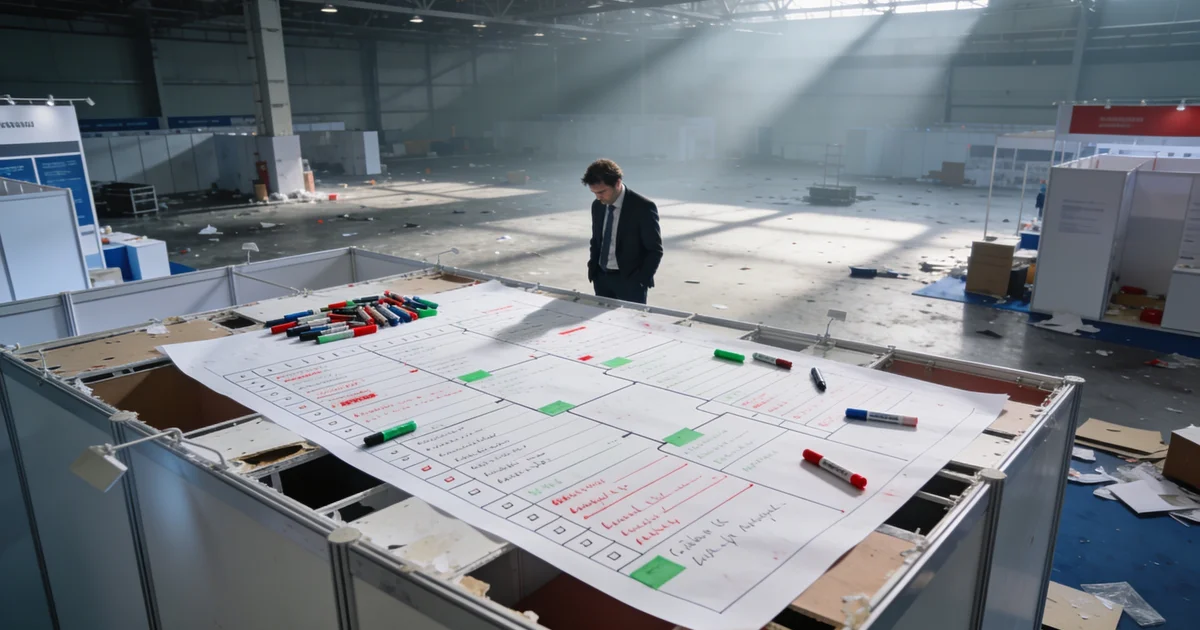
Post-show lifecycle beyond follow-up emails — freight out, expense close, CRM handoff, day-14 debrief, and rebook/kill decisions before next year's budget.

Article
Short answer: After a trade show ends, run a cross-team lifecycle — not just follow-up emails. Day 0: teardown, freight and I&D out, asset inventory. Days 1–2: lead handoff and CRM dedupe. Days 3–7: sales executes the follow-up calendar while finance closes expenses. Day 14: debrief, ROI review, and a rebook/kill decision. Our follow-up timeline guide covers when emails send; this guide covers what each team does after the hall closes.
When I review post-show debriefs across exhibitor teams, the gap is rarely copy. Marketing has templates. Sales knows hot from cold. What breaks is the handoff between functions — logistics ships the booth while nobody inventories missing monitors, finance chases receipts six weeks later, and leadership rebooks the same fair because nobody ran ROI against alternatives on ExhibitionsVoice. This 2026 guide maps the full post-show lifecycle: operations, sales, marketing, finance, and leadership from show close through day 14. For email timing and tier cadence, use our follow-up timeline and email framework; this page is the org chart in motion.
Follow-up timing vs post-show wrap-up
Three related guides, three jobs:
- Timeline guide — day 0–14 email calendar by hot, warm, and cold tier
- Email framework — tier rules, subject-line logic, CRM fields, send SLAs
- This lifecycle guide — what ops, sales, marketing, finance, and leadership do after doors close
Teams that only load the timeline still lose deals to freight delays, dirty CRM handoffs, and rebook decisions made before expenses close. Wrap-up is the infrastructure that makes follow-up possible.
Post-show lifecycle by team (days 0–14)
| Window | Ops / logistics | Sales / marketing | Finance | Leadership |
|---|---|---|---|---|
| Day 0 | Teardown, freight/I&D release, asset inventory vs packing list | Hot-lead Slack or CRM alerts; lock booth notes before travel | Capture drayage and freight invoices on-site | — |
| Day 1–2 | Ship-back confirmation; damage claims filed | Lead handoff, dedupe, tier QA, missing-field fix | Receipt upload deadline to AP | — |
| Day 3–7 | Storage routing; asset repair queue | Follow-up execution per timeline; nurture monitoring | Expense close — all-in cost draft | Review hot-pipeline stallers |
| Day 14 | Asset status report (repair, storage, next show) | Pipeline + reply rate by tier | Final all-in cost locked | Debrief; Rebook / Improve / Kill |
Print this table on the show brief next to the follow-up calendar. When someone asks "who owns post-show?" the answer is everyone — on a schedule.
Day 0: freight, I&D out, and asset inventory
Show close is not "everyone to the airport." Day 0 is the highest-risk window for asset loss and surprise drayage bills. I require a named ops lead on the floor until the last crate is scanned out:
- Teardown against packing list — reconcile every item you shipped in against our trade show packing checklist; missing tablets and monitor arms show up as emergency rentals at the next fair
- I&D release — confirm labor sign-off, empty booth photos if the venue requires them, and no orphaned crates on the aisle
- Freight labels and pickup window — wrong carrier or missed window means storage fees that never hit marketing's ROI model
- Damage log with photos — file before the truck departs; claims filed Monday rarely succeed
- CRM note lock — booth team cannot edit conversation hooks after day 0; sales works from what was captured on the floor
Sales still owns hot-lead alerts on day 0 — but ops owns the booth assets that make the next show possible. Running both in parallel prevents the classic failure: pipeline emails go out while the demo hardware sits in a warehouse nobody tagged.
Day 1–2: lead handoff between booth and CRM owners
The handoff is where scan count becomes pipeline. Marketing ops — not the AE who flew home — runs this sequence:
- Export and dedupe — merge duplicate company records from multi-day scans within 24 hours
- Tier QA — spot-check hot tags against booth notes; downgrade anything without budget path or timeline
- Missing-field fix — company name, title, show source tag, and one personalization hook per warm/hot record
- RACI confirmation — named AE for hot, SDR or AE for warm, marketing automation ID for cold — per the email framework signed before travel
By end of day 2, every tier has an owner and a queue — not a shared inbox labeled "trade show leads." Booth staff should be off the hook for CRM hygiene by day 2 so they can debrief capture quality honestly at day 14.
Day 3–7: follow-up execution across teams
Days 3–7 is when the follow-up timeline runs in production — but this guide focuses on team actions, not send times:
- Sales — executes hot escalation and warm value-add touches; manager visibility on hot leads with no reply by day 3
- Marketing — monitors cold nurture sequences; pulls engaged cold records to SDR handoff
- Marketing ops — daily dedupe and bounce handling; broken emails on day 4 waste day 0 effort
- Finance — closes expenses (see below) so ROI math uses real denominators
- Leadership — 15-minute stand-up on hot pipeline stallers; no rebook talk yet — data is still forming
If follow-up stalls during days 3–7, diagnose handoff and tier QA before blaming subject lines. Most stalls I audit trace to day 1–2 gaps, not day 5 copy.
Expense close: feed the ROI denominator
Finance should target expense close within 7–10 days of show close. Delayed close is how teams rebook shows with inflated ROI — booth space was only part of the spend.
Line items I require before day 14 debrief:
- Booth space and build or rental
- Freight, drayage, and storage
- I&D labor and overtime
- Travel, hotels, and per diem
- Lead capture tools, scanners, and badge fees
- Attributable sales and marketing hours for post-show follow-up
Roll the total into the trade show ROI formula — if booth space is more than 35–40% of all-in cost, something is missing from the close. Finance and marketing ops share one spreadsheet tagged to the show source ID; leadership should not see pipeline metrics without a matched cost column.
Day 14 debrief: cross-functional agenda
Two weeks after close, run a 45-minute debrief while booth notes and freight receipts are still findable. I use this agenda:
- Ops — asset status (repair queue, storage fees, readiness for next show)
- Sales / marketing — reply rate by tier, meetings booked, pipeline influenced with show source tag
- Finance — final all-in cost and cost per qualified meeting
- Capture quality — percent of records with personalization hook; tier downgrade rate from QA
- ROI scorecard — score against the ROI measurement framework, not raw scan count
Document one page: what worked, what broke, what changes before the next move-in. Skipping ops and finance in the debrief produces sales-only retros that repeat logistics failures.
ROI review and rebook / improve / kill decision
Day 14 closes with a decision gate — not vibes. I use three thresholds:
- Rebook — cost per qualified meeting and pipeline influenced beat your baseline; capture and follow-up executed cleanly
- Improve — fair ICP fit but execution failed (handoff, tier QA, expense timing); same show with fixed playbook
- Kill — weak ICP density or ROI below threshold after clean execution; budget redeployed
Before locking Rebook, shortlist two alternates on ExhibitionsVoice with comparable buyer density and lower all-in cost. Leadership signs the decision before finance opens next year's line item — otherwise you default to "we always do this show."
Pre-show: load the lifecycle before move-in
This lifecycle only works if assigned before freight ships:
- Named day 0 ops lead — stays until last crate out
- Handoff RACI — booth → marketing ops → tier owners by day 2
- Expense close owner in finance — with 7-day SLA and show cost code
- Day 14 debrief on calendars — ops, sales, marketing, finance, leadership
- Rebook criteria written — thresholds tied to ROI formula, not last year's habit
Pair this prep with the follow-up timeline loaded in CRM before travel. Wrap-up without follow-up wastes leads; follow-up without wrap-up wastes budget.
FAQ
What should you do immediately after a trade show ends?
Day 0: complete teardown inventory against your packing list, release I&D, confirm freight pickup, log asset damage, and lock CRM booth notes. Sales triggers hot-lead alerts the same day — logistics and pipeline both start before anyone flies home.
Who is responsible for post-show lead handoff?
Booth team exports scans and conversation hooks to marketing ops within 24 hours; ops dedupes and tier-QA by day 2; named AE, SDR, and marketing automation owners take hot, warm, and cold queues per the pre-show RACI. Handoff is a process with deadlines, not a Monday email from sales.
When should you close trade show expenses?
Target expense close within 7–10 days of show close while receipts, drayage bills, and labor invoices are still accessible. Delayed close inflates ROI denominators and blocks accurate rebook decisions at day 14.
How long after a trade show should you debrief?
Day 14 — long enough for meetings to book and expenses to close, short enough that booth context is fresh. Include ops (asset status), sales (pipeline by tier), finance (all-in cost), and leadership (rebook/kill).
When should you decide to rebook a trade show?
At the day 14 debrief after ROI review: compare cost per qualified meeting and pipeline influenced to your threshold and to alternate shows on the calendar. Document Rebook, Improve, or Kill before next year's budget line opens.
What is the difference between post-show follow-up and post-show wrap-up?
Follow-up is sales and marketing outreach timing — when emails send, which tier gets escalation. Wrap-up is the full cross-team lifecycle: freight out, lead handoff, expense close, debrief, and rebook decision. You need both; they are not the same checklist.
Post-show lifecycle by team (days 0–14)
| Window | Ops / logistics | Sales / marketing | Finance | Leadership |
|---|---|---|---|---|
| Day 0 | Teardown, freight/I&D out, asset inventory | Hot-lead alerts; CRM notes lock | Capture drayage/freight invoices | — |
| Day 1–2 | Ship-back confirmation; damage claims | Lead handoff, dedupe, tier QA | Receipt upload deadline | — |
| Day 3–7 | Storage routing; asset repair queue | Follow-up execution per timeline guide | Expense close | — |
| Day 14 | Asset status report | Pipeline + reply metrics | Final all-in cost | Debrief; rebook/kill |
Day 0: freight, I&D out, and asset inventory
Teardown checklist against packing list; freight labels, I&D release, photo damage log before truck departs.
Day 1–2: lead handoff between booth and CRM owners
Dedupe, tier QA, missing-field fix — handoff from booth team to named AE/SDR/marketing owners. Structure from email framework; timing from timeline guide.
Day 3–7: follow-up execution (not timing)
Sales runs the calendar; marketing ops monitors nurture; leadership reviews hot-pipeline stallers. This post covers team actions — the timeline post covers WHEN each email sends.
Expense close and all-in cost capture
Finance closes within 7–10 days: booth, freight, drayage, labor, travel, hotels, scanners. Feed totals into ROI formula.
Day 14 debrief, ROI review, and rebook/kill
45-min debrief: pipeline by show tag, cost per qualified meeting, Pass/Improve/Rebook/Kill. Score with ROI measurement guide; shortlist alternatives on ExhibitionsVoice.
Common exhibitor questions
What should you do immediately after a trade show ends?
Day 0: complete teardown inventory against your packing list, release I&D, confirm freight pickup, log asset damage, and lock CRM booth notes. Sales triggers hot-lead alerts the same day — logistics and pipeline both start before anyone flies home.
Who is responsible for post-show lead handoff?
Booth team exports scans and conversation hooks to marketing ops within 24 hours; ops dedupes and tier-QA by day 2; named AE/SDR/marketing owners take hot, warm, and cold queues per the pre-show RACI. Handoff is a process, not a Monday email from sales.
When should you close trade show expenses?
Target expense close within 7–10 days of show close while receipts, drayage bills, and labor invoices are still accessible. Delayed close inflates ROI denominators and blocks accurate rebook decisions.
How long after a trade show should you debrief?
Day 14 — long enough for meetings to book and expenses to close, short enough that booth context is fresh. Include ops (asset status), sales (pipeline by tier), finance (all-in cost), and leadership (rebook/kill).
When should you decide to rebook a trade show?
At the day 14 debrief after ROI review: compare cost per qualified meeting and pipeline influenced to your threshold and to alternate shows on the calendar. Document Rebook, Improve, or Kill before next year's budget line opens.
What is the difference between post-show follow-up and post-show wrap-up?
Follow-up is sales and marketing outreach timing (when emails send). Wrap-up is the full cross-team lifecycle: freight out, lead handoff, expense close, debrief, and rebook decision. You need both; they are not the same checklist.
Editorial standards & corrections
This guide is maintained by the ExhibitionsVoice editorial team. We cross-check dates, venues, and organizer names against official sources before listing events. Spot an error? Use our contact form with the event URL and corrected details — every correction request is read by editorial.
Read more: About ExhibitionsVoice · FAQs · All exhibitor guides
Related articles
Oil and gas trade shows 2026: energy calendar and how to pick
Oil and gas trade shows for 2026 — ADIPEC, WETEX, and offshore energy fairs we score for NOC, IOC, and energy-tech exhibitors.

CPHI India 2026 exhibitor guide: Delhi pharma ingredients floor
CPHI India 2026 exhibitor guide for 23-25 November at IICC Yashobhoomi, New Delhi — API, CDMO, and packaging teams scoring South Asia's ingredients floor.

Fintech trade shows 2026: payments calendar and how to pick
Fintech and payments trade shows for 2026 — Money20/20 USA, Sibos, and how banks and vendors pick Tier A/B/C money-ecosystem floors.
ADIPEC 2026 exhibitor guide: Abu Dhabi energy floor
ADIPEC 2026 exhibitor guide for 2-5 November at ADNEC Centre Abu Dhabi — who should exhibit, hall logistics, and how we score the energy floor.