
Article
Event lead generation for trade show exhibitors
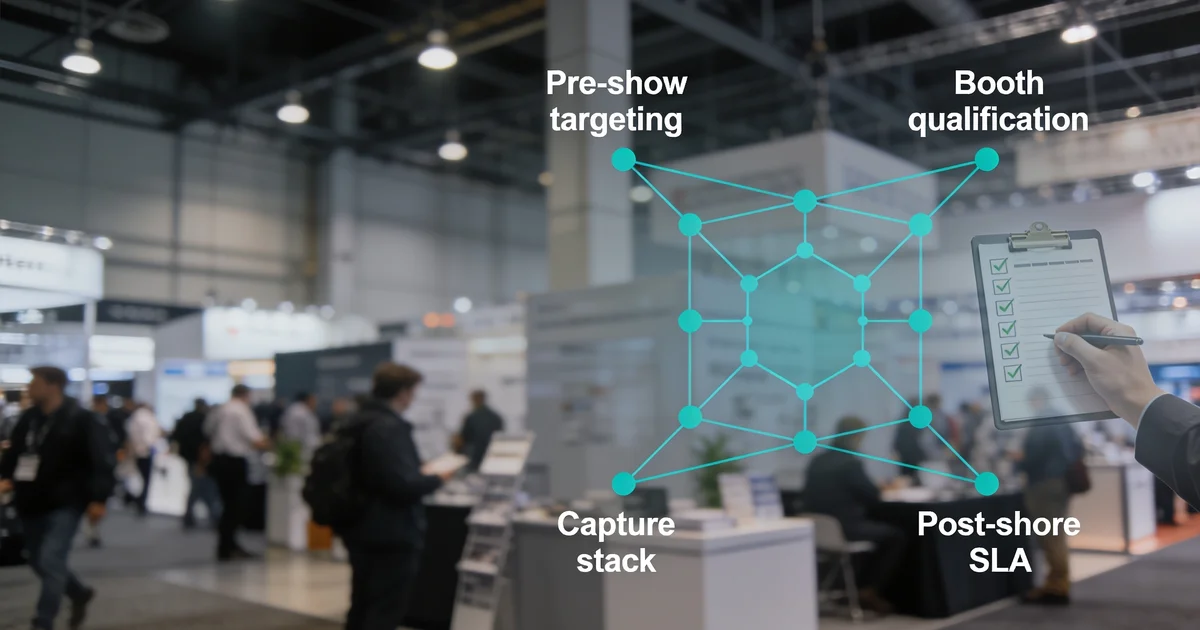
Event lead generation for exhibitors — pre-show targeting, booth qualification, capture stack, and post-show SLA — mapped as one pipeline, not three disconnected tactics.
Article
Short answer: Event lead generation at trade shows is one end-to-end exhibitor pipeline — pre-show show selection and ICP targeting on verified directory data, a show brief with pipeline targets and named owners, during-show qualify → capture → tier with daily standups, and post-show day 0–14 follow-up SLA plus ROI debrief. It is not a badge scanner purchase, a Monday email blast, or three teams running disconnected tactics.
When I audit exhibitor programs before show season, event lead generation almost always arrives as fragments. Marketing owns pre-show outreach but never talks to sales about pipeline targets. Booth reps scan badges without qualification. Post-show follow-up starts when someone finds time — usually Tuesday. Each piece looks reasonable alone; together they leak pipeline at every handoff. This guide maps the full pipeline we recommend for 2026: what runs before travel, what runs on the floor, what runs in the fourteen days after close, and how the loop feeds your next calendar decision. For the capture mechanics alone, see our dual-capture lead workflow. For qualification on the aisle, see the two-minute qualify script. This page connects those playbooks into one system.
One boundary up front: ExhibitionsVoice is a trade show directory. We do not sell leads, attendee lists, lead capture software, or organizer data feeds. Event lead generation here means exhibitor workflows your team owns — not buying pre-show attendee files or treating directory research as a list purchase.
What event lead generation means as one pipeline
Search results for "event lead generation" mix booth tactics, software lists, and generic B2B outbound advice. Exhibitors need a narrower map with four connected phases:
- Pre-show: pick the right fair, confirm ICP density, set pipeline target and roles
- During: qualify conversations, capture with context, assign tier, route hot leads same day
- Post-show (days 0–14): tier-specific follow-up SLA with owners assigned before travel home
- Debrief: measure qualified meetings and pipeline influenced; rebook or kill the show on evidence
Break any link and the pipeline fails quietly. A strong capture stack without qualification fills CRM with names. Fast follow-up without pre-show targeting sends assets to the wrong segment. ROI math without agreed definitions produces arguments, not budget renewals. The sections below follow this sequence — not because order is elegant, but because each phase produces data the next phase requires.
Pre-show: show selection and ICP targeting
Event lead generation starts before booth deposit — not at move-in. I shortlist fairs on ExhibitionsVoice, then stress-test each candidate against ICP density using our Tier A/B/C show selection framework.
What I verify before recommending a show to an exhibitor team:
- Sector overlap — exhibitor categories and visitor profiles match your buyer, not just your product category label
- Geography — pipeline geography aligns with sales territories; a strong fair in the wrong region inflates scan count, not revenue
- Calendar tier — Tier A flagships get full staffing and pipeline targets; Tier C validation booths get qualify-first discipline and lower meeting expectations
- Competitive density — twelve identical vendors on the same aisle changes your hook strategy and expected qualified meeting volume
ICP targeting at this stage means a named account list or segment definition — role titles, company size band, eval triggers, disqualifiers — checked against verified show context. I do not treat "everyone who walks the hall" as a target. Pre-show outreach (email, LinkedIn, meeting requests) runs only against accounts that pass ICP review. Outreach without ICP fit is noise that booth teams confuse with pipeline.
Show selection is the highest-leverage lead gen step. Fix the calendar on directory data before you optimize scanner apps or email templates.
Pre-show: show brief, roles, and pipeline targets
Thirty days before doors open, every exhibitor team I advise gets a one-page show brief — shared doc, show tag in the title, signed by marketing and sales leadership. No brief, no pipeline accountability.
| Brief section | What it locks | Why it matters |
|---|---|---|
| Pipeline target | Qualified meeting count by tier (hot / warm / cold) | Sets staffing and tells finance what success looks like |
| Tier definitions | Hot = timeline under 90 days + budget path + next step agreed | Same language on floor and in CRM |
| RACI | Named owners for hot AE outreach, warm asset send, cold nurture, data hygiene | Prevents Monday inbox orphan leads |
| Follow-up SLA | Hot same day; warm 24h; cold nurture day 2 — cross-ref follow-up timeline | Owners know deadlines before travel |
| Capture + qualify refs | Links to dual-capture workflow and qualify script in booth playbook | Reps rehearse the loop, not just the demo |
| ROI variables | All-in cost estimate, qualified meeting definition, 90-day pipeline attribution rule | Day 14 debrief uses same math as pre-show plan |
Pipeline target drives booth staffing. A Tier B regional with a target of eight qualified meetings needs different rep count and demo depth than a Tier A flagship targeting twenty-four. I calibrate targets to calendar tier — not to last year's scan count, which rewards badge volume over buyer fit.
During: qualify, capture, tier — in that order
On the floor, event lead generation is a sequence, not a scanner habit. I watch teams violate the order constantly: scan first, ask questions never, wonder why CRM is useless Monday.
Step 1 — Qualify: four questions from the two-minute qualify script — role, timeline, authority path, current vendor. Cold traffic gets a polite redirect, not a scan you will never action.
Step 2 — Capture: only after qualification, run the dual-capture stack — scanner plus manual backup — with CRM required fields filled before the visitor leaves your zone. Conversation hook, next step, and owner are non-negotiable.
Step 3 — Tier: hot, warm, or cold assigned at the same moment as capture. Tier drives follow-up SLA and Slack escalation — not a post-show guess from marketing ops.
I do not re-teach capture mechanics here; that playbook covers shift handoffs, same-day dedupe, and end-of-shift audit. At the pipeline level, the rule is simple: qualification gates capture, capture carries context, tier gates speed.
During: daily standups and hot-lead routing
Multi-day fairs need a daily rhythm — not just end-of-show cleanup. Each morning, booth lead runs a fifteen-minute standup with scanning reps and the assigned AE:
- Yesterday's hot count — CRM rows with tier, hook, owner, and Slack ack confirmed
- Pending manual-backup rows — photos or paper log entries not yet in CRM
- Open demos or meetings — promised times that need AE calendar action today
- Scanner / Wi-Fi status — dead zones and sync lag from prior shift handoff log
- Today's pipeline focus — named accounts from pre-show ICP list vs open walk-up traffic
Hot-lead routing means the named AE acknowledges within minutes of a hot tier tag — demo pulled forward, meeting slot offered, or aisle walk-back while the buyer is still on site. Buyers book with whoever responds first; a perfect email on day 3 loses to a mediocre reply on day 0. Same-day response is part of event lead generation, not a post-show marketing task.
Post-show: follow-up SLA (days 0–14)
Post-show is where most pipelines die — not from bad copy, but from missing calendar discipline. I require teams to run the tier schedule in our perfect follow-up timeline with owners assigned in the show brief before anyone boards a flight home.
Hot tier: human outreach same day — ideally within four hours, before leaving the hall when possible. Reference the conversation hook from CRM; single CTA; no invented meeting times.
Warm tier: promised asset within twenty-four hours — case study, one-pager, or recording — with the hook from booth notes in paragraph one.
Cold tier: nurture sequence starting day 2 — not day 0 spam, not day 14 when show memory is gone.
Days 3–7: escalation for non-replies on hot and warm tiers — phone, LinkedIn, or AE direct, per RACI.
Day 14: debrief count — qualified meetings vs target, pipeline stage movement, show source tags complete. Post-show lead gen is not "send emails until someone replies." It is a tier calendar with named owners and a hard stop for rebook decisions.
Post-show: ROI debrief and calendar loop
Event lead generation closes the loop when day 14 numbers feed the 2027 calendar. I apply the trade show ROI formula with variables locked in the pre-show brief — all-in cost, qualified meeting count, pipeline influenced within ninety days with show source tagged in CRM.
Rebook signals: qualified meetings at or above tier target, cost per qualified meeting within Tier A/B/C range, pipeline advancing to opportunity stage within ninety days.
Kill or downgrade signals: scan volume high but qualified meetings low (qualification failure), cost per meeting double tier benchmark (wrong show or wrong staffing), pipeline attributed but not advancing (follow-up or ICP mismatch).
The debrief is not a marketing retrospective — it is a calendar decision. Tier A that misses pipeline target twice gets downgraded or cut. Tier C validation that hits ICP density gets promoted. Without the pipeline map, teams rebook on brand nostalgia and repeat the same leaks next cycle.
Pipeline checklist (pre, during, post)
- 60–90 days out: shortlist shows on ExhibitionsVoice; ICP density check; calendar tier assigned
- 30 days out: show brief signed — pipeline target, RACI, tier definitions, ROI variables
- 7 days out: booth rehearsal — mock qualify → capture → tier → hot routing
- Daily on floor: morning standup; qualify before capture; hot ack within minutes
- Day 0–14 post-show: tier follow-up calendar; dedupe and data hygiene in first 24 hours
- Day 14: ROI debrief; rebook / downgrade / kill decision on evidence
Teams that run this loop on one show brief outperform teams with better scanner apps and no connected pipeline. Event lead generation is systems work — the booth conversation is just the middle chapter.
FAQ
What is event lead generation for trade show exhibitors?
A connected pipeline: pre-show show selection and ICP targeting on verified directory data, a show brief with pipeline targets and RACI, during-show qualify-capture-tier with daily standups and hot-lead routing, post-show day 0–14 follow-up SLA, and a day 14 ROI debrief that feeds the next calendar cycle. It is not a single tactic or software purchase.
How do you build a trade show lead generation pipeline?
Map four phases on one show brief: pre-show targeting and named roles, during-show qualify-then-capture-then-tier with same-day hot routing, post-show tier calendar with CRM owners assigned before travel home, and ROI measurement with agreed definitions for qualified meeting and pipeline influenced. Link each phase to the capture, qualify, and follow-up playbooks your team already runs.
When should you start event lead generation before a trade show?
Sixty to ninety days out for show selection and ICP density check on verified directory data. Thirty days out for a signed show brief with pipeline target, RACI, and follow-up owners. Seven days out for booth team rehearsal of the qualify-capture-tier loop under aisle pressure.
What is the most important step during event lead generation on the floor?
Qualification before capture. Tier tags and conversation hooks must be assigned while the buyer is still in your zone. Scanning without qualify fills CRM with names you will never action and breaks post-show SLAs — no hook means no day 0 email, regardless of how fast your scanner syncs.
How long should trade show lead follow-up take after the event?
Hot leads: same day, ideally within four hours before leaving the hall. Warm: promised asset within twenty-four hours. Cold: nurture starting day 2. Escalate non-replies on hot and warm tiers through day 7; run a day 14 debrief tied to ROI variables and rebook decisions.
How do you measure event lead generation ROI from a trade show?
Use definitions locked in the pre-show brief: all-in cost (not booth rent alone), qualified meeting count with ICP criteria confirmed in CRM, and pipeline influenced within ninety days with show source tagged. Apply the ROI formula at day 14 and compare cost per qualified meeting against your calendar tier expectations — then rebook, downgrade, or kill the show on evidence.
What event lead generation means as one pipeline
Event lead gen = pre-show targeting + during qualify-capture-tier + post-show follow-up SLA + ROI debrief. Not three disconnected tactics. Differentiate from AI lead gen and capture-stack-only guides.
Pre-show: show selection and ICP targeting
Shortlist fairs on ExhibitionsVoice using Tier A/B/C from show selection framework. Score ICP density before booth spend — not after CRM export.
Pre-show: show brief, roles, and pipeline targets
One-page brief: qualified meeting target, tier definitions, RACI for hot/warm/cold, follow-up SLA owners named 30 days before doors. Pipeline target sets staffing — not hope.
During: qualify, capture, tier — in order
Run two-minute qualify script before scan. Capture via dual-capture workflow. Assign tier at same moment — hot/warm/cold drives SLA.
During: daily standups and hot-lead routing
15-minute morning standup: yesterday's hot count, pending manual rows, owner acks. Hot tier → named AE within minutes — not Monday queue.
Post-show: follow-up SLA (days 0–14)
Hot same day, warm day 1 asset, cold nurture day 2+. Full calendar in follow-up timeline. Owners assigned before travel home.
Post-show: ROI debrief and calendar loop
Day 14 debrief: qualified meetings vs target, pipeline influenced at 90 days, cost per meeting. Math in ROI formula. Rebook or kill show on tier evidence — not gut feel.
Common exhibitor questions
What is event lead generation for trade show exhibitors?
A connected pipeline: pre-show show selection and ICP targeting on verified directory data, a show brief with pipeline targets and RACI, during-show qualify-capture-tier with daily standups, post-show day 0–14 follow-up SLA, and a day 14 ROI debrief that feeds the next calendar cycle.
How do you build a trade show lead generation pipeline?
Map four phases on one show brief: pre-show targeting and roles, during-show qualify-then-capture-then-tier with hot-lead routing, post-show tier calendar with named CRM owners, and ROI measurement with agreed definitions for qualified meeting and pipeline influenced.
When should you start event lead generation before a trade show?
60–90 days out for show selection and ICP density check; 30 days out for signed show brief with pipeline target, RACI, and follow-up owners; 7 days out for booth team rehearsal of qualify-capture-tier loop.
What is the most important step during event lead generation on the floor?
Qualification before capture. Tier tags and conversation hooks must be assigned while the buyer is still in your zone — scanning without qualify fills CRM with names you will never action and breaks post-show SLAs.
How long should trade show lead follow-up take after the event?
Hot leads: same day, ideally within four hours before leaving the hall. Warm: promised asset within 24 hours. Cold: nurture starting day 2. Full escalation through day 14 with a debrief tied to ROI variables.
How do you measure event lead generation ROI from a trade show?
Use agreed definitions locked in the pre-show brief: all-in cost, qualified meeting count, and pipeline influenced within 90 days with show source tagged in CRM. Apply the ROI formula at day 14 and compare cost per qualified meeting against your calendar tier expectations.
Editorial standards & corrections
This guide is maintained by the ExhibitionsVoice editorial team. We cross-check dates, venues, and organizer names against official sources before listing events. Spot an error? Use our contact form with the event URL and corrected details — every correction request is read by editorial.
Read more: About ExhibitionsVoice · FAQs · All exhibitor guides
Related articles
Oil and gas trade shows 2026: energy calendar and how to pick
Oil and gas trade shows for 2026 — ADIPEC, WETEX, and offshore energy fairs we score for NOC, IOC, and energy-tech exhibitors.

CPHI India 2026 exhibitor guide: Delhi pharma ingredients floor
CPHI India 2026 exhibitor guide for 23-25 November at IICC Yashobhoomi, New Delhi — API, CDMO, and packaging teams scoring South Asia's ingredients floor.

Fintech trade shows 2026: payments calendar and how to pick
Fintech and payments trade shows for 2026 — Money20/20 USA, Sibos, and how banks and vendors pick Tier A/B/C money-ecosystem floors.
ADIPEC 2026 exhibitor guide: Abu Dhabi energy floor
ADIPEC 2026 exhibitor guide for 2-5 November at ADNEC Centre Abu Dhabi — who should exhibit, hall logistics, and how we score the energy floor.